
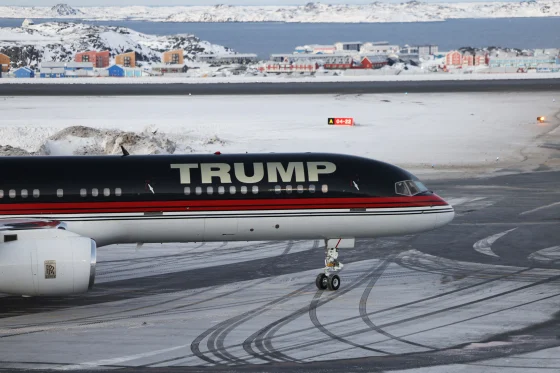
President Donald Trump is intensifying his long-standing push to bring Greenland under U.S. control, with a senior administration official claiming that meaningful steps could happen within weeks or months. This aggressive stance has sparked widespread concern in the Arctic island’s small population and drawn sharp rebukes from Denmark and Greenland’s leaders, who insist the territory is not for sale and belongs to its people.
Thomas Dans, America’s Arctic commissioner and a longtime advocate for Trump’s interest in Greenland, described the process as moving “at high speed.” In an interview with USA TODAY, he compared it to a “train route with multiple stops,” explaining that things could proceed “on an express basis,” skipping slower steps and heading straight to the main goal. Dans, who has focused on this issue since 2020, said Trump is determined not to back down, and while a full acquisition would require time to build trust with Greenlanders, noticeable progress might come soon. He emphasized that gaining local support would take effort, but transactional elements could advance quickly.
Trump has repeatedly framed Greenland as essential for U.S. national security, pointing to its strategic location in the Arctic and vast natural resources. The world’s largest island is rich in critical minerals needed for electronics and green technology, plus potential oil, gas, and uranium deposits. As melting ice opens new shipping routes and exposes these assets, Trump argues that without U.S. control, Russia or China could gain influence there. He has said he prefers an “easy way” through negotiation but warned of a “hard way” if needed, refusing to rule out military options. In recent statements, he insisted the U.S. will “have” Greenland “one way or the other,” adding that failure to act would leave Russia or China as neighbors.
Greenland, a semi-autonomous territory of Denmark with about 57,000 mostly Inuit residents, has firmly rejected these ideas. Polls show that while many want eventual independence from Denmark, almost no one supports becoming part of the United States or the 51st state. Leaders from multiple Greenlandic parties have united in statements declaring, “We don’t want to be Americans, we don’t want to be Danes, we want to be Greenlanders.” Prime Minister Jens-Frederik Nielsen has stressed peaceful cooperation and said, “We choose Denmark, NATO, and the EU.”
The rhetoric has caused real anxiety on the ground. Naaja Nathanielsen, Greenland’s minister for business and mineral resources, called the U.S. discussions “unfathomable” during a meeting with British lawmakers. She described people as “very, very worried,” with some unable to sleep and children afraid. “It just fills everything these days. And we can’t really understand it,” she said. Nathanielsen added that Greenland feels “betrayed” despite years of seeking more collaboration with the U.S., and emphasized that the island is home—not just land to be bought or taken.
Denmark’s leaders echo this defiance. Prime Minister Mette Frederiksen has warned that any U.S. military move would end NATO itself, calling the situation a “fateful moment” for the alliance. Danish officials have ridiculed suggestions of invasion, with one parliament member noting that any attempt to remove Danish forces would mean war. They point to existing defense agreements, including the U.S. Pituffik Space Base, and plan increased NATO presence in the Arctic, including multinational exercises in 2026.
Tensions have led to high-level diplomacy. Vice President JD Vance and Secretary of State Marco Rubio were set to meet Denmark’s Foreign Minister Lars Løkke Rasmussen and Greenland’s Foreign Minister Vivian Motzfeldt at the White House to address the issue. Denmark requested the talks amid Trump’s escalating comments. European allies, including the UK, Germany, France, and others, have backed Greenland’s right to self-determination.
Trump’s interest dates back to his first term in 2019, but it has surged since his return to office, fueled by Arctic competition and resource potential. While invasion fears appear overstated—Dans called them misplaced—the push has created uncertainty and fear in Greenland, where residents worry about their future being decided by outsiders. As one official put it, for Greenlanders, this is about identity and home, not just geopolitics or minerals. The coming weeks could reveal whether Trump’s “high speed” approach leads to negotiation, escalation, or stalemate.