
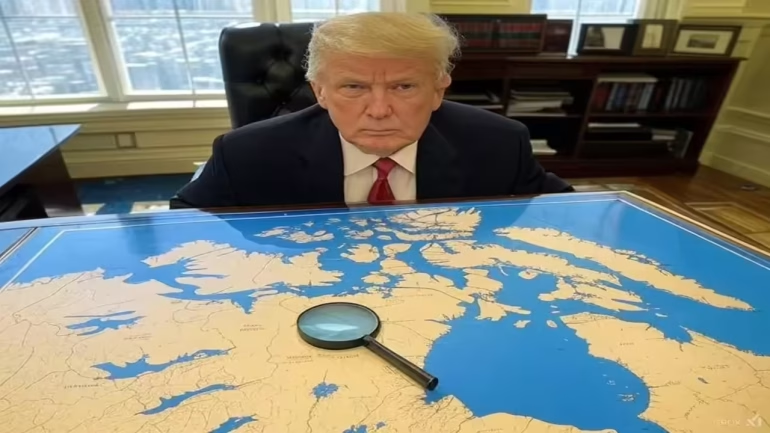
Greenland’s Prime Minister Jens-Frederik Nielsen has urged the island’s residents to prepare for “everything,” including the unlikely but not impossible possibility of U.S. military action. This comes amid escalating threats from President Donald Trump, who has repeatedly insisted on acquiring the semi-autonomous Danish territory for national security reasons.
Speaking at a news conference in Nuuk, Greenland’s capital, on Tuesday, January 20, 2026, Nielsen emphasized caution despite calling a military conflict “not likely.” He pointed out that the U.S. side has not explicitly ruled out force, forcing Greenland to take the threats seriously.
“It is not likely that there will be a use of military force, but it has not been ruled out yet,” Nielsen said, referring to Trump’s statements. “This leader from the other side has made it very clear that it is not ruled out. And therefore we must of course be prepared for everything.”
Greenland, with a population of about 57,000, is part of the Kingdom of Denmark but handles most internal affairs, while Denmark manages defense and foreign policy. The island holds strategic importance in the Arctic due to its location, natural resources, and existing U.S. military presence at Pituffik Space Base.
Preparations Underway
In response to the tensions, Greenland’s government is launching an information campaign to guide citizens. This includes practical advice, such as stocking at least five days’ worth of food and other essentials at home. Officials are also forming an emergency response team involving municipal authorities, police, and Denmark’s Joint Arctic Command to handle potential disruptions.
Former Prime Minister Mute B. Egede, now serving as finance minister and deputy prime minister, joined Nielsen at the conference. He stressed the need to review civil preparedness strategies and prepare for various scenarios. “We must be prepared for all the things that may happen,” Egede said.
Greenlandic leaders have condemned Trump’s approach as disrespectful and reaffirmed that the island is not for sale. They prefer to remain aligned with Denmark if forced to choose.
Denmark and NATO’s Response
Denmark has increased its military footprint in Greenland to address the “changed security policy situation.” Recent moves include deploying additional troops—around 100 soldiers along with the Danish Army chief—and expanding exercises with NATO allies, including Operation Arctic Endurance involving multiple North Atlantic countries. Danish officials described these steps as necessary to defend the Arctic and North Atlantic, where the U.S. is also a NATO member.
Danish Prime Minister Mette Frederiksen has criticized Trump’s threats as risking conflict between the U.S. and Europe. She warned that a trade war would harm jobs and economies on both sides and stressed that neither Danes nor Greenlanders want to be at the center of such a dispute.
Trump’s Position
President Trump has doubled down on his demands, calling Greenland essential for U.S. national security, including missile defense plans like the “Golden Dome.” He has refused to detail his strategy, telling reporters, “You’ll find out,” when asked how far he would go. Trump has threatened tariffs—starting at 10% on February 1 and rising to 25% by June 1—on several European NATO allies if they block a deal. He has downplayed potential European resistance, saying they “can’t protect it” and won’t “push back too much.”
No official U.S. plans for an invasion have been confirmed, according to reports from American officials.
Broader Implications
The standoff has rattled NATO allies, sparked protests in Greenland and Denmark (including demonstrations with slogans like “Hands off Greenland”), and raised fears of broader economic retaliation from Europe. Greenland’s leaders warn that any escalation could affect the entire Western alliance, given the island’s NATO ties.
While military action remains seen as improbable, the situation highlights growing tensions over Arctic control, resources, and alliances in a changing global landscape. Greenlanders and their leaders are focusing on readiness while hoping for a peaceful resolution through diplomacy.