
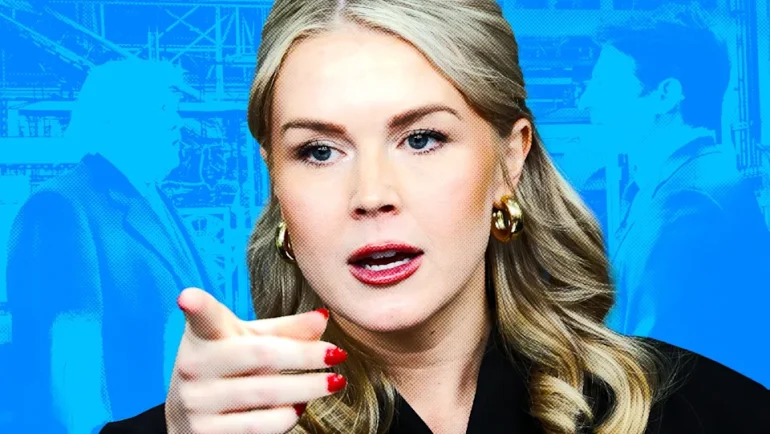
A recent confrontation between the White House and CBS News has drawn renewed attention to the fragile relationship between political power and the press in the United States. At the center of the dispute is a blunt legal threat reportedly delivered by White House press secretary Karoline Leavitt, who warned CBS that the network would face a lawsuit if it edited an interview with President Donald Trump on CBS Evening News.
The exchange, first reported by The New York Times, took place moments after CBS anchor Tony Dokoupil completed a 13-minute interview with Trump at a Ford assembly plant in Dearborn, Michigan. According to audio reviewed by the newspaper, Leavitt approached Dokoupil and other CBS staff members with a message she said came directly from the president.
“He said, ‘Make sure you guys don’t cut the tape, make sure the interview is out in full,’” Leavitt told them. Dokoupil responded that CBS was planning to do exactly that. Leavitt then escalated the message: “If it’s not out in full, we’ll sue your ass off.”
The remark was met with mixed reactions. CBS Evening News executive producer Kim Harvey replied, “Oh, great, OK,” while Dokoupil attempted to defuse the situation with humor, reportedly saying, “He always says that!” However, The New York Times noted that Leavitt did not laugh, and her tone suggested the warning was serious. Although some CBS staffers present believed the comment might have been made in jest, the threat reflected broader tensions between the Trump administration and major media outlets.
Later that evening, CBS aired the interview in full, just as Leavitt had demanded. During the broadcast, Trump discussed a wide range of issues, including Iran, immigration policy, and the killing of Renee Good by an ICE agent in Minneapolis earlier in the month. He also sharply criticized Federal Reserve Chair Jerome Powell, calling him “lousy,” and warned that the United States would take “very strong action” if Iran executed protesters.
The interview was also notable for Trump’s repeated personal comments directed at Dokoupil. Four separate times, Trump told the anchor that he would not have his job if Kamala Harris had won the 2024 presidential election. At the end of the segment, Dokoupil addressed the remark directly, saying, “For the record, I do think I’d have this job even if the other guys won.” Trump replied, “Yeah, but at a lesser salary.”
After reports of the legal threat became public, CBS News strongly defended its editorial independence. In a statement, the network said, “The moment we booked this interview, we made the independent decision to air it unedited and in its entirety.” CBS emphasized that the choice had been made before any warning from the White House.
Leavitt, for her part, stood by her comments. Speaking to The New York Times, she said, “The American people deserve to watch President Trump’s full interviews, unedited, no cuts. And guess what? The interview ran in full.” Her statement framed the issue not as intimidation, but as a demand for transparency.
The clash cannot be separated from recent history between Trump and CBS. In 2024, Trump sued the network over its editing of a 60 Minutes interview with then–Vice President Kamala Harris, claiming the edits were designed to mislead viewers during the presidential campaign. CBS denied the accusation, arguing that the interview had been edited only for time, a standard practice in broadcast journalism. Nevertheless, CBS’s parent company, Paramount, agreed to a $16 million settlement. While Paramount did not admit wrongdoing, part of the payment covered Trump’s legal fees, and some of the money was directed toward funding his future presidential library.
That settlement continues to loom large over CBS News. Media critics have argued that it may have encouraged the Trump administration to use legal threats as leverage against the network. The current controversy has only intensified those concerns, especially as CBS undergoes major changes behind the scenes.
Paramount recently completed an $8 billion merger with Skydance, a media company founded by David Ellison, the son of Oracle billionaire Larry Ellison, who is known to be friendly with Trump. At the same time, CBS News has faced internal and external scrutiny over its editorial leadership. Critics have questioned whether corporate ownership, political relationships, and recent legal battles could influence how aggressively the network covers the administration.
For journalists and press freedom advocates, the episode raises troubling questions. While airing full interviews can be a legitimate editorial choice, the idea that a sitting president might threaten lawsuits to control how news organizations present information strikes many as an abuse of power. Others argue that Trump’s demand reflects long-standing frustration with media editing practices and a desire to speak directly to the public without mediation.
In the end, CBS did exactly what it said it planned to do: air the interview unedited. But the circumstances surrounding that decision have sparked a wider debate. As the Trump administration continues its second term, the confrontation with CBS stands as a reminder that the struggle between political authority and journalistic independence is far from over—and that the pressure placed on the press can sometimes be as revealing as the news itself.