
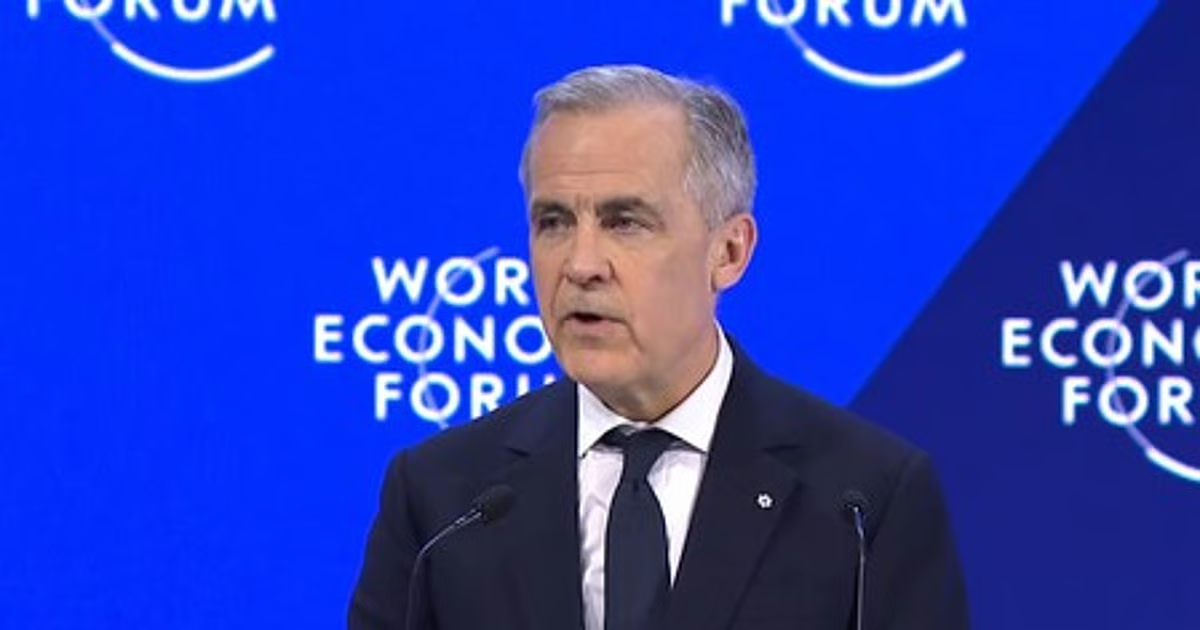
In a dramatic escalation of already strained relations between the United States and Canada, U.S. President Donald Trump has withdrawn an invitation for Canada to join his newly formed “Board of Peace.” The announcement came via a post on Truth Social late Thursday evening, addressed directly to Canadian Prime Minister Mark Carney.
Trump wrote: “Please let this Letter serve to represent that the Board of Peace is withdrawing its invitation to you regarding Canada’s joining, what will be, the most prestigious Board of Leaders ever assembled, at any time.”
Trump did not explain the reason for the sudden reversal in his post. However, the move follows sharp public exchanges between the two leaders in recent days, particularly during the World Economic Forum in Davos, Switzerland.
The Board of Peace, chaired by Trump (with the charter suggesting he could hold the position for life), was initially presented as a mechanism to oversee the implementation of a ceasefire and reconstruction in Gaza following a prolonged conflict between Israel and Hamas. Endorsed by a United Nations Security Council resolution tied to Trump’s Gaza peace plan, the body has since been described by Trump as having a much broader mandate—to resolve global conflicts and potentially rival or supplement functions of the United Nations.
Permanent membership requires a $1 billion contribution to fund operations, though some reports describe this as voluntary or negotiable. Around 35 countries have reportedly signed on so far, including nations like Argentina, Belarus, Morocco, Vietnam, Pakistan, Egypt, Turkey, Qatar, Jordan, Indonesia, Saudi Arabia, and others from the Middle East and emerging economies. Notably absent are major Western allies and permanent UN Security Council members such as China, France, Russia (still considering), and the United Kingdom.
European leaders have voiced reservations. European Council President Antonio Costa expressed “serious doubts” about the board’s scope, governance, and compatibility with the UN Charter, though he indicated willingness to collaborate on Gaza-related efforts. France called the charter “incompatible” with its commitments, and Spain declined participation outright. The UK cited concerns over including Russian President Vladimir Putin.
Canada had initially signaled interest. Last week, Carney indicated he would accept the invitation “in principle,” pending details on structure, operations, and financing. However, Canadian officials, including Finance Minister François-Philippe Champagne, made clear that Canada would not pay the $1 billion fee.
The rift deepened at Davos. In a well-received speech on January 20, Carney warned of a “rupture” in the U.S.-led “rules-based international order.” He criticized great powers for weaponizing economic tools like tariffs, supply chains, and financial systems, urging “middle powers” to unite: “If you are not at the table, you are on the menu.” The address earned a rare standing ovation.
Trump responded sharply during his own remarks at the forum, claiming Canada receives “many freebies” from the U.S. and should be “grateful.” He declared, “Canada lives because of the United States. Remember that, Mark, the next time you make your statements.” Earlier, Trump shared an AI-altered image on social media showing Canada (along with Greenland and Venezuela) under American flags.
Back in Canada, Carney fired back during a speech in Quebec: “Canada doesn’t live because of the United States. Canada thrives because we are Canadians.”
The episode highlights broader strains in U.S.-Canada relations during Trump’s second term. Trump has repeatedly referred to Canada as a potential “51st state” and imposed or threatened tariffs. Carney has worked to diversify Canada’s trade, including a recent deal with China to reduce tariffs on Canadian agriculture and increase EV imports, while pursuing ties in the Middle East.
In Canada, Carney’s firm stance has boosted his popularity. Polls show approval above 50%, with cross-party praise for confronting perceived U.S. economic coercion. Experts note a surge in national pride, reduced U.S. travel, and boycotts of American goods amid sovereignty concerns.
The Board of Peace’s future remains uncertain, with limited buy-in from traditional U.S. allies. While Trump insists it will operate “in conjunction with the United Nations,” critics worry it could undermine the established global order. For now, the public snub of Canada underscores the personal and geopolitical frictions driving the initiative. Neither Carney’s office nor the White House immediately commented on the withdrawal.