
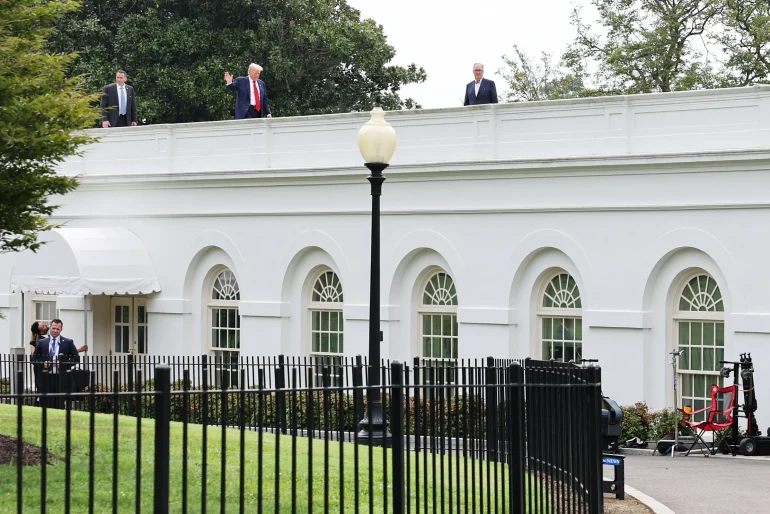
President Donald Trump recently claimed that a lawsuit challenging his ambitious White House ballroom project has accidentally revealed a previously classified detail about national security involvement in the construction.
In a January 25, 2026, post on Truth Social, Trump defended the $300–400 million addition, describing it as a “gift” to the nation funded entirely by private donors rather than taxpayers. He argued that no president has ever needed permission to modify or improve the White House grounds due to their unique status. More pointedly, Trump stated that the project has proceeded with the “design, consent, and approval of the highest levels of the United States Military and Secret Service.” He accused the lawsuit of exposing this “heretofore Top Secret fact” simply by bringing the case forward.
The controversy stems from the National Trust for Historic Preservation, a nonprofit group dedicated to protecting historic sites, which filed a lawsuit in December 2025 against Trump and several federal agencies. The suit seeks to halt construction, arguing that the project bypassed required federal review processes, including environmental assessments, public input, and congressional authorization. The East Wing of the White House was demolished in October 2025 to clear space for the new 90,000-square-foot ballroom, which is designed to hold about 1,000 people for state events and other large gatherings. This represents a significant expansion from initial July 2025 plans, which called for a smaller space seating 650 at a $200 million cost.
Trump dismissed the lawsuit as “ridiculous” and “baseless,” insisting that it’s too late to stop the work. He noted that key materials—including structural steel, windows, doors, HVAC equipment, marble, stone, precast concrete, bulletproof glass, and anti-drone roofing—have already been ordered or prepared, making reversal impractical.
A federal court hearing took place on January 22, 2026, before U.S. District Judge Richard Leon in Washington, D.C. During the session, Leon expressed skepticism about the administration’s legal arguments, questioning whether Trump has the authority to demolish part of the White House and build the ballroom without congressional oversight or other approvals. He reportedly responded sharply to comparisons with smaller past renovations, such as the swimming pool added during Gerald Ford’s presidency, saying, “Come on, be serious.”
The White House has maintained that the National Capital Planning Commission (NCPC)—which advises on federal construction in the D.C. area—lacks jurisdiction over the demolition phase and is only reviewing the building plans. The demolition itself was not subject to the National Historic Preservation Act of 1966, which protects many historic structures but explicitly exempts the White House, along with the Supreme Court and U.S. Capitol.
In court filings, a Secret Service official emphasized that completing the project is essential for protecting the president, first family, and White House complex. The administration has also highlighted security features in the design, including an updated underground facility tied to the long-standing Presidential Emergency Operations Center (PEOC), originally built as a bomb shelter under President Franklin D. Roosevelt during World War II.
Financing for the ballroom has drawn attention as well. Trump has stressed that the funds come from private “patriot donors,” including major American companies such as Palantir, Lockheed Martin, and Meta, which have business interests with the government. Ethical questions have arisen about whether such donations could influence policy decisions, though the White House insists the project involves no taxpayer money.
The NCPC is scheduled to vote on the construction plans in early March 2026, with opportunities for public comment opening in mid-February. Judge Leon is expected to rule soon on whether to issue a preliminary injunction halting work.
Trump’s ballroom initiative has sparked debate over presidential authority, historic preservation, private funding of public spaces, and national security priorities. While supporters see it as a needed upgrade for hosting large events, critics view the rapid demolition and proceeding construction as bypassing standard oversight for one of the country’s most iconic buildings.