
President Donald Trump has made one of his strongest statements yet on Iran, declaring that regime change in the country “would be the best thing that could happen.” His comments come amid heightened tensions, ongoing nuclear negotiations, and a significant U.S. military buildup in the Middle East.
Speaking to reporters after addressing military families at Fort Bragg in North Carolina on February 13, 2026, Trump expressed frustration with decades of stalled diplomacy with Iran’s leadership. “For 47 years, they’ve been talking and talking and talking,” he said. “In the meantime, we’ve lost a lot of lives while they talk. Legs blown off, arms blown off, faces blown off. We’ve been going on for a long time.” When directly asked if he supported regime change—meaning the replacement of Iran’s current clerical government led by Supreme Leader Ayatollah Ali Khamenei—Trump replied, “It seems like that would be the best thing that could happen.” He did not name any specific individuals or groups he would prefer to see in power, only noting that “there are people” who could take over.
Trump’s remarks mark a clear shift toward openly endorsing the idea of ousting Iran’s regime, even as his administration pursues indirect talks with Tehran. U.S. envoys, including Steve Witkoff and Jared Kushner, are scheduled to meet Iranian representatives in Geneva, mediated by Oman, to discuss limiting Iran’s nuclear program. The U.S. demands also include curbs on Iran’s ballistic missiles, its support for proxy groups like Hamas and Hezbollah, and improvements in human rights. Iran insists its nuclear activities are for peaceful energy purposes and has offered limits in exchange for sanctions relief, but it refuses to link those issues to its missile program or regional alliances.
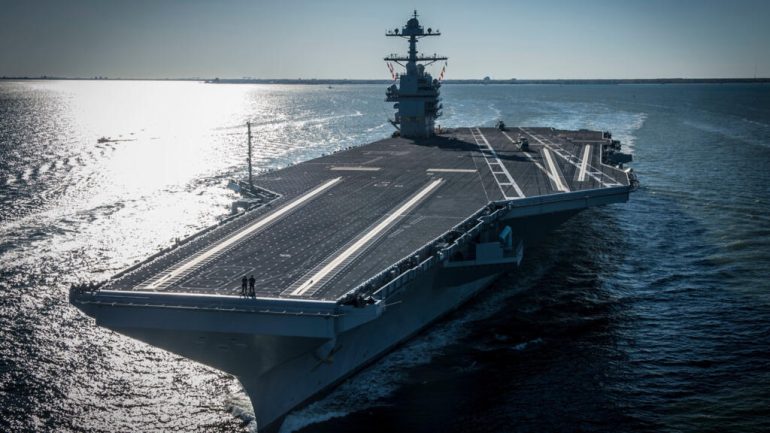
Adding to the pressure, the U.S. military is repositioning major assets to the region. Trump confirmed that the USS Gerald R. Ford—the world’s largest aircraft carrier—is being redirected “very soon” from the Caribbean to join the USS Abraham Lincoln and other ships already in the Middle East. This deployment follows earlier U.S. strikes on Iranian nuclear facilities in 2025 and aims to strengthen leverage in negotiations. Trump described the move as preparation “in case we don’t make a deal,” warning that failure to reach an agreement “will be bad for Iran.”
Reports indicate the Pentagon is actively planning for more extensive scenarios. According to Reuters, U.S. officials are preparing for the possibility of sustained, weeks-long military operations against Iran if Trump orders strikes. These could target not only nuclear sites but also state and security facilities, potentially leading to a broader conflict than previous limited actions. Such planning reflects concerns over Iran’s missile capabilities and possible retaliation against U.S. bases in the region.
Trump’s comments and the military movements occur against a backdrop of broader foreign policy debates. Critics, including Representative Alexandria Ocasio-Cortez speaking at a Munich panel, have accused the administration of damaging U.S. global standing through abrupt shifts in alliances and agreements. Meanwhile, domestic issues like immigration enforcement controversies and a looming Department of Homeland Security funding crisis continue to dominate headlines in Washington.
As talks proceed and forces amass, the situation underscores the high stakes: a potential diplomatic breakthrough on Iran’s nuclear ambitions or escalation toward military confrontation and regime change pressures. Iran has warned of strong retaliation to any attack, while Trump maintains that diplomacy remains an option—but one backed by overwhelming force.