
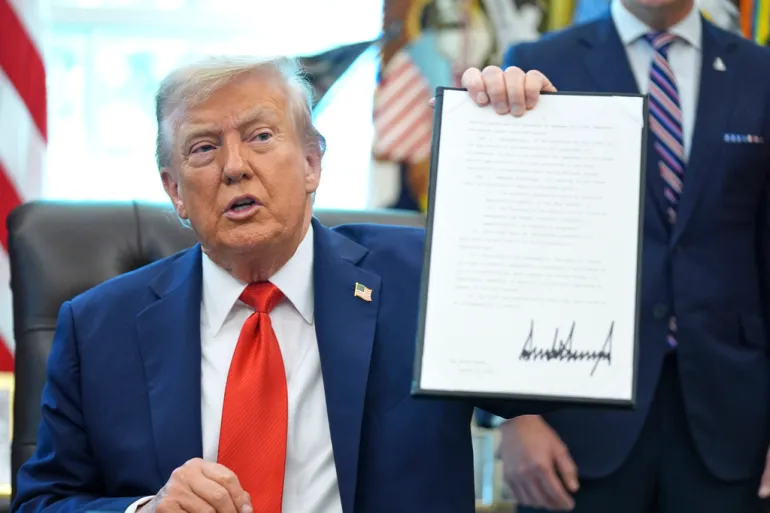
President Donald Trump announced on February 13, 2026, that he plans to issue an executive order to require voter identification for the upcoming 2026 midterm elections, even if Congress does not pass related legislation.
In posts on his social media platform Truth Social, Trump expressed frustration with Democrats for opposing voter ID requirements and proof of citizenship for voting. He accused them of wanting to “cheat” in elections and claimed this goes against the intentions of the nation’s founders. “There will be Voter I.D. for the Midterm Elections, whether approved by Congress or not!” he wrote in one post. In another, he added that he had researched “legal arguments not yet articulated or vetted” and would soon present what he called an “irrefutable” case through an executive order.
Trump’s statements came shortly after the House of Representatives passed the SAVE America Act (also referred to as the Safeguard American Voter Eligibility Act or SAVE Act) on February 11, 2026, in a close 218-213 vote. The bill, backed by Trump and House Republicans, would require proof of U.S. citizenship—such as a passport or birth certificate—to register to vote in federal elections and a photo ID to cast a ballot. It also includes other changes, like restrictions on mail-in voting. Only one Democrat voted in favor, while nearly all Republicans supported it.
However, the legislation faces major obstacles in the Senate. Republicans hold a slim majority with 53 seats, but passing the bill would require 60 votes to overcome a filibuster. Senate Minority Leader Chuck Schumer has called it “dead on arrival” and described it as a “fringe” effort to make voting harder, comparing it to Jim Crow-era restrictions. Sen. Lisa Murkowski (R-Alaska) has publicly opposed the bill, and only Sen. John Fetterman (D-Penn.) among Democrats has expressed support for national voter ID rules—though he opposes other limits like those on mail-in ballots. Voting rights groups, such as the Brennan Center for Justice, argue that such requirements could disenfranchise millions of eligible voters, especially low-income people, minorities, and those (like some married women) who lack matching documents.
Trump has pushed for greater federal control over elections, which are traditionally managed by states under the U.S. Constitution. The document gives states authority over the “times, places, and manner” of holding elections for Congress. Experts, including law professors from Stanford and UCLA, have said a presidential executive order mandating national voter ID rules would likely be unconstitutional, as the president lacks unilateral power to override state election procedures. A similar executive order Trump issued earlier was blocked by a federal judge, who ruled it exceeded presidential authority. Legal challenges would probably delay or stop any new order before the midterms.
Trump has long claimed widespread election fraud, including false assertions about the 2020 election, despite little evidence of significant noncitizen voting or other irregularities. Voter fraud remains extremely rare, and noncitizen voting is already illegal under federal law.
Public opinion shows strong support for voter ID: A 2025 Pew Research Center study found about 83% of Americans favor requiring photo ID to vote, including 95% of Republicans and 71% of Democrats. Many states already have some form of voter ID laws, though they vary in strictness.
Trump framed the issue as critical to the midterms, urging Republicans to highlight it in campaigns. He warned that if Democrats gain control of Congress, they could add states, pack the Supreme Court, and end the filibuster—changes he said would harm the country.
As of mid-February 2026, no executive order has been issued, and the SAVE America Act remains stalled in the Senate. Trump’s threat has sparked debate about election security versus access to voting, with Republicans viewing it as a way to protect integrity and critics seeing it as an attempt to suppress turnout ahead of a high-stakes election.