
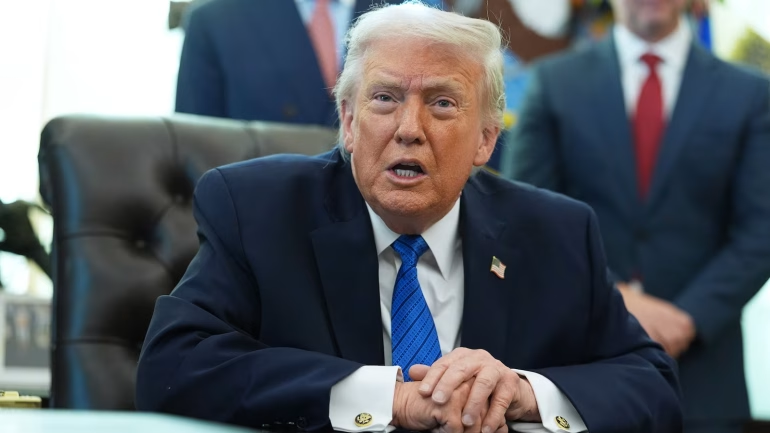
President Donald Trump has signaled a potential shift in his administration’s approach to immigration enforcement, suggesting the need for a “softer touch” following intense backlash in Minnesota. This comes as federal authorities announced the immediate withdrawal of about 700 immigration agents from the state, reducing but not eliminating a large-scale operation that has sparked protests and national controversy.
The crackdown, known as Operation Metro Surge, ramped up in late 2025 and involved thousands of federal agents from Immigration and Customs Enforcement (ICE) and Customs and Border Protection (CBP) deployed to Minneapolis and surrounding areas. The surge targeted individuals in the country illegally, with officials emphasizing arrests of those accused of serious crimes, including homicides, assaults, sex offenses, and gang activity.
Tensions escalated dramatically last month when two U.S. citizens were fatally shot during encounters with federal agents. Renee Good, a 37-year-old mother of three, was killed while attempting to drive away from ICE agents. Two weeks later, Alex Pretti, also 37 and an intensive care nurse, was beaten and shot while pinned to the ground. Both incidents drew widespread outrage, video evidence contradicting initial government accounts, massive protests, and calls for independent investigations. The deaths highlighted concerns over the use of force and aggressive tactics in the operation.
In response, Trump replaced the initial commander overseeing the effort with White House border czar Tom Homan, who has focused on de-escalation. On February 4, 2026, Homan announced the drawdown of roughly 700 agents—about a quarter of the force—effective immediately. Around 2,000 agents remain in Minnesota, a significant increase from the pre-surge level of about 150. Homan attributed the reduction to improved cooperation from some state and local officials, including agreements for jails to hand over certain immigrants directly to federal custody rather than requiring street-level arrests. He also prioritized issuing body-worn cameras to agents in Minneapolis, with plans to expand nationwide.
Trump personally confirmed he ordered the pullback in an interview with NBC News. He described the fatal shootings as “very sad incidents” that “should not have happened,” expressing unhappiness with the outcomes while noting that neither victim was “an angel.” He stressed that operations remain focused on “really bad criminals” and insisted law enforcement deserves support.
However, Trump acknowledged lessons from the Minnesota situation: “I learned that maybe we could use a little bit of a softer touch. But you still have to be tough.” He mentioned conversations with Minnesota Governor Tim Walz and Minneapolis Mayor Jacob Frey, describing them as positive.
Walz and Frey welcomed the partial drawdown as “a step in the right direction” but criticized it as insufficient. Walz called for a “faster and larger” reduction, state-led probes into the killings, and an end to what he termed a “campaign of retribution.” Frey demanded the operation cease immediately, arguing that 2,000 remaining agents do not represent true de-escalation.
Homan maintained that the mission continues until goals are met, including broader mass deportations promised during Trump’s campaign. He conditioned a full withdrawal on sustained local cooperation and reduced interference with agents, such as protests blocking operations.
The Minnesota events have intensified scrutiny of Trump’s immigration policies, with public opinion polls showing declining approval on the issue. Amid the pressure, the administration has emphasized targeted enforcement and adjustments like better equipment and coordination to balance security with public concerns.
While the drawdown marks a tactical adjustment, it remains unclear whether it signals a broader softening of the administration’s hardline stance on immigration nationwide.