
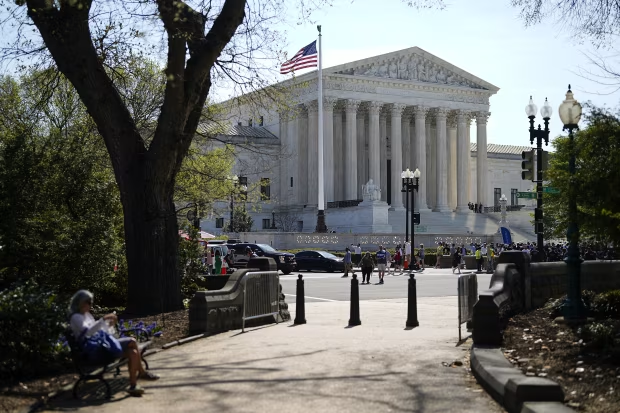
On Wednesday, the Supreme Court heard more than two hours of arguments in a high-stakes case over President Donald Trump’s executive order that seeks to end automatic U.S. citizenship for children born on American soil to undocumented immigrants or temporary foreign visitors. A victory for the administration could reshape the meaning of American citizenship and affect hundreds of thousands of newborns each year.
President Trump made history by attending the first part of the arguments, sitting in the public gallery as his solicitor general defended the policy. It was the first time a sitting president has observed oral arguments at the Supreme Court. Trump left after the government’s presentation concluded.
The case centers on the Citizenship Clause of the 14th Amendment, ratified in 1868 after the Civil War. The amendment states that “all persons born or naturalized in the United States and subject to the jurisdiction thereof” are citizens. For more than a century, this has been understood to guarantee birthright citizenship to nearly everyone born on U.S. soil, regardless of their parents’ immigration status. A key 1898 Supreme Court precedent, United States v. Wong Kim Ark, affirmed that a child born in San Francisco to Chinese immigrant parents was a U.S. citizen.
Trump signed the executive order on his first day back in office in January 2025. Lower courts quickly blocked it, calling it unconstitutional. The order has never taken effect and would apply only to future births. Challengers, including expectant parents represented by the American Civil Liberties Union (ACLU), argue that the president cannot override a constitutional guarantee through executive action.
During the arguments, the justices asked tough questions of both sides, leaving the final outcome uncertain. Several conservative justices expressed doubts about the administration’s position.
Key Moments from the Arguments
Solicitor General D. John Sauer argued that the 14th Amendment was meant mainly for formerly enslaved people and their descendants. He said undocumented immigrants and temporary visitors lack full “allegiance” to the United States and are not “domiciled” here, so their children should not receive automatic citizenship. Sauer urged the court to “correct long-enduring misconceptions” without overturning the Wong Kim Ark precedent.
However, Chief Justice John G. Roberts Jr. and other justices pressed Sauer on the meaning of “domicile” in that 1898 ruling. The word appears about 20 times, but the challengers’ lawyer, Cecillia Wang of the ACLU, said it was just a description of the facts, not the legal heart of the decision. Justices Neil Gorsuch and Elena Kagan noted that the congressional debates over the 14th Amendment did not focus on parents’ status or use the term “domicile.”
Justice Amy Coney Barrett raised practical concerns. She asked what would happen to foundlings—abandoned babies whose parents are unknown. Under the administration’s view, such infants might be left stateless if their parents’ status could not be proven. Sauer pointed to a 1952 federal law that grants citizenship to young children of unknown parentage found in the U.S., but Barrett pressed whether the Constitution itself would allow that.
The justices also seemed uninterested in policy arguments, such as “birth tourism” or how other countries handle citizenship. Chief Justice Roberts asked Sauer whether concerns about foreigners coming to the U.S. to have babies should affect the legal analysis. Sauer admitted birth tourism was not an issue in the 19th century. Roberts replied, “It’s a new world. It’s the same Constitution.”
Justice Brett Kavanaugh suggested two possible ways the court could rule against the administration without a sweeping constitutional decision. One would rely on the Wong Kim Ark precedent. The other would focus on the 1952 law that also guarantees birthright citizenship. The court often prefers to decide cases on narrower statutory grounds when possible. Sauer indicated he would prefer to lose on the statute, which would let the administration push Congress for new legislation.
Broader Implications
A ruling in favor of the Trump administration could strip automatic citizenship from an estimated 200,000 babies born each year to undocumented immigrants. Opponents warn it would create chaos for families, lead to mixed-status households, and even affect children of lawful temporary visa holders, such as students or workers from countries like India and China. Studies suggest it could disproportionately impact certain communities and expand the undocumented population over time.
The challengers say the 14th Amendment was designed to place birthright citizenship beyond the reach of any single branch of government. They point to English common law traditions of citizenship by birthplace.
The case is part of several this term testing the limits of Trump’s second-term policies. Earlier, the court struck down his administration’s broad tariffs.
A decision is expected by late June or early July 2026.
Outside the courthouse, demonstrators on both sides gathered. Supporters of birthright citizenship, including descendants of Wong Kim Ark and activist Chef Jose Andrés, emphasized America’s tradition of inclusion. Others, like law professor John Eastman, viewed the arguments as a serious originalist debate rather than a fringe idea.
Trump reacted on social media after leaving the court, repeating claims that the U.S. is uniquely “stupid” for allowing birthright citizenship—a statement fact-checkers note is incorrect, as more than 30 countries practice some form of it.
The arguments highlighted deep divisions over immigration, history, and constitutional interpretation. While some conservative justices showed skepticism toward limiting birthright citizenship, the probing questions on both sides mean the final vote remains unclear. The outcome could redefine who counts as an American for generations to come.