
For weeks, China stayed mostly in the background of the escalating conflict between the United States, Israel, and Iran. Beijing played a quiet but important role, relying on its strong ties with Tehran while the U.S. military actions disrupted global oil supplies and rattled the world economy. That low-key approach ended on Tuesday, April 14, 2026, when China issued its strongest public criticism yet of American policy in the region.
Chinese officials sharply condemned the U.S. blockade of Iranian ports, calling it “dangerous and irresponsible.” They warned that the move would only heighten tensions, weaken the fragile ceasefire, and threaten safe passage through the Strait of Hormuz. The strait is a critical waterway that normally carries about one-fifth of the world’s oil and natural gas. More than half of China’s energy imports pass through it, making Beijing especially sensitive to any disruption.
Foreign Ministry spokesperson Guo Jiakun told reporters that such actions “will only intensify contradictions, exacerbate tensions, undermine the already fragile ceasefire, and further jeopardize the security of navigation through the strait.”
President Xi Jinping also spoke out directly for the first time on the issue. During a meeting in Beijing with Sheikh Khaled bin Mohamed bin Zayed Al Nahyan, the crown prince of Abu Dhabi, Xi stressed the need to protect international law. “It must not be selectively applied or disregarded, nor should the world be allowed to regress to the law of the jungle,” he said, according to a Chinese Foreign Ministry statement.
The comments mark Beijing’s most significant public intervention in the Iran war so far. China has close economic and political ties with Iran and has repeatedly called for a peaceful resolution. It has criticized both U.S.-Israeli strikes on Iran and Iran’s retaliatory attacks on Gulf states. President Donald Trump himself has pointed to China as a key player that could help bring Iran back to the negotiating table for a lasting ceasefire.
Pressure on Beijing to Act
The U.S. blockade has put growing pressure on China, the world’s largest importer of crude oil. While Beijing has more economic resilience than many of its Asian neighbors, a prolonged shutdown of the Strait of Hormuz threatens China’s energy security and could seriously damage its economy.
Chinese leaders are also worried about Iran’s strikes on Gulf countries, where Beijing has major commercial investments. “If the Middle East countries will be just one after another falling into the conflict, then it will be very detrimental to China’s investment in the Middle East,” said Zhu Feng, dean of the School of International Studies at Nanjing University.
Despite the pressure, China is not interested in military involvement in the region. Its strategy remains focused on diplomacy.
Diplomacy on Display
In recent days, Beijing has hosted several high-level foreign visitors, using the opportunity to highlight its role as a responsible global player in contrast to U.S. actions. Spanish Prime Minister Pedro Sánchez, on his fourth visit to China in as many years, said Tuesday that it would be “very difficult to find other interlocutors, beyond China, who can resolve this situation.”
Sánchez has drawn criticism from Trump for refusing to let the United States use Spanish airspace or military bases in connection with the Iran conflict.
China’s balancing act is delicate. It wants to protect its interests in Iran and the broader Middle East without triggering a direct clash with Washington. This is especially important ahead of Trump’s planned visit to China next month.
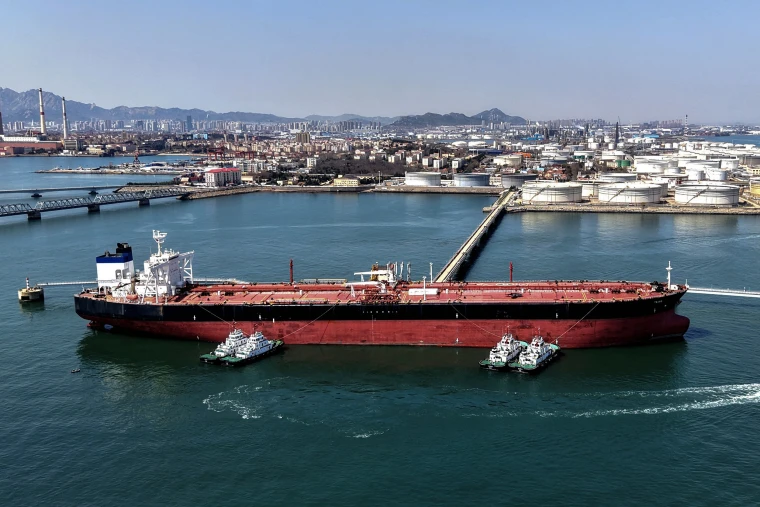
An oil tanker was seen unloading crude at the port in Qingdao, in China’s eastern Shandong province, last week, underscoring how vital these sea routes remain for the Chinese economy.
As the Iran war continues to threaten global stability, China’s louder voice signals that Beijing is no longer willing to stay entirely on the sidelines. Whether its influence can actually help end the fighting remains to be seen, but its growing diplomatic efforts show just how deeply the conflict affects the world’s second-largest economy.