
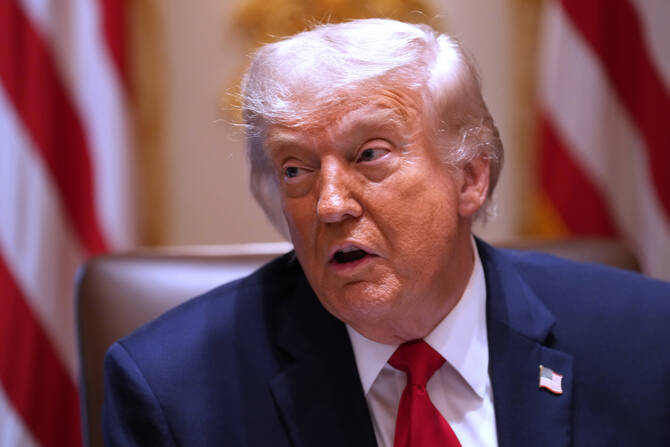
President Donald Trump said Friday he is meeting with top advisers in the White House Situation Room to reach a “final determination” on a proposed deal that would extend the ceasefire with Iran and reopen the critical Strait of Hormuz.
The talks come one day after reports emerged that U.S. and Iranian negotiators had reached a tentative agreement. The proposed deal would extend the fragile ceasefire by 60 days while both sides continue negotiations over Iran’s nuclear program. However, Iranian officials said Friday that no final agreement has been reached.
Trump emphasized his core demands in a social media post. “Iran must agree that they will never have a Nuclear Weapon or Bomb,” he wrote. He also insisted that the Strait of Hormuz must be fully reopened to international navigation and that all sea mines must be destroyed.
Lingering Distrust on Both Sides
Iran’s top negotiator, Mohammad Bagher Qalibaf, expressed deep skepticism about the agreement. “We have no trust in guarantees or words,” he wrote on X, “only actions.” He added that Iran does not win concessions through talks, but through strength.
Foreign Ministry spokesman Esmail Baghaei echoed this position, telling state media that the agreement “has not been finalized yet.” He said Iranian officials are currently focused on ending the war rather than discussing detailed nuclear terms.
Vice President JD Vance struck a more optimistic tone on Thursday. While acknowledging that the original goal was to prevent Iran from ever obtaining a nuclear weapon, Vance said the U.S. had succeeded in setting back Iran’s program significantly “over the long term.”
Nuclear Program Remains a Major Issue
Iran currently possesses about 441 kilograms of uranium enriched to 60% purity, according to the International Atomic Energy Agency. This is only a short technical step away from weapons-grade levels of 90%. The material is believed to be stored deep underground at sites that were heavily damaged by U.S. strikes last year.
Trump has renewed his demand that this stockpile be removed and destroyed under U.S. and IAEA supervision. Iran has long maintained that its nuclear program is for peaceful purposes and has not agreed to give up the material.
Reopening the Strait of Hormuz
A key part of the proposed deal involves reopening the Strait of Hormuz, a narrow waterway between Iran and Oman through which about one-fifth of the world’s oil and gas normally passes. Iran has effectively closed the strait since the conflict began, causing global fuel prices to rise sharply.
Under the tentative agreement, Iran would not be allowed to charge tolls on ships passing through the strait and would have to remove all mines within 30 days. In return, the U.S. would gradually lift its blockade on Iranian ports and ease some sanctions, allowing Iran to sell more oil on the international market.
Iran has said it would work with Oman to manage the strait based on their national interests and those of the international community. Earlier Friday, the foreign ministers of Iran and Oman spoke by phone about the issue.
Ongoing Tensions
The ceasefire, now about seven weeks old, has been shaky. Both sides have traded strikes and accused each other of violations, but full-scale fighting has not resumed. Iran also wants any final deal to include a truce between Israel and Hezbollah militants in Lebanon, where clashes have continued despite an earlier ceasefire agreement.
As Trump and his team weigh their next steps in the Situation Room, the stakes remain high. Success could ease global energy prices and reduce the risk of renewed war in the Middle East. Failure could lead to further escalation in a conflict that has already claimed senior Iranian leaders and disrupted international trade.