
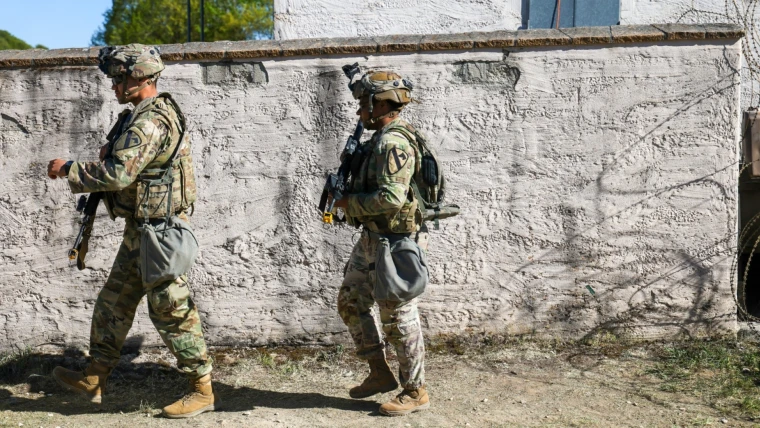
President Donald Trump’s decision to withdraw 5,000 U.S. troops from Germany has drawn sharp criticism from top Republicans in Congress, who say the move risks weakening America’s deterrence against Russia.
On Saturday, Sen. Roger Wicker of Mississippi and Rep. Mike Rogers of Alabama — the leading Republicans on the Senate and House Armed Services Committees — issued a joint statement expressing serious concern over the troop reduction.
“We are very concerned by the decision to withdraw a U.S. brigade from Germany,” they said. The lawmakers stressed that it is in America’s interest to keep a strong military presence in Europe. They warned that cutting troops too soon could send the wrong signal to Russian President Vladimir Putin and undermine deterrence while European allies work to build up their own defenses.
Trump signaled that even bigger cuts could be coming. Speaking to reporters Saturday, he said, “We’re going to cut way down, and we’re cutting a lot further than 5,000.”
The move follows weeks of tension between the Trump administration and European allies. It appears to have been triggered in part by comments from German Chancellor Friedrich Merz, who earlier this week said the U.S. was “being humiliated by the Iranian leadership.” Germany currently hosts nearly 40,000 U.S. troops — the largest American military presence in Europe.
European Reactions
European leaders have responded with a mix of acceptance and alarm. German Defense Minister Boris Pistorius called the withdrawal “foreseeable” and repeated that Europeans must take greater responsibility for their own security.
Polish Prime Minister Donald Tusk took a stronger stance, describing the growing rift between Europe and the United States as a “disastrous trend.” In a post on X, Tusk said the biggest threat to the transatlantic alliance comes not from outside enemies but from its own internal divisions. He added that the issue will likely come up when European leaders meet soon in Yerevan, Armenia.
At last year’s NATO Summit in The Hague, member countries agreed to raise defense spending to 5% of gross domestic product by 2035. Wicker and Rogers acknowledged that Europe is increasing spending but warned that turning those investments into real military capability will take time.
“Prematurely reducing America’s forward presence in Europe before those capabilities are fully realized risks undermining deterrence and sending the wrong signal to Vladimir Putin,” they said.
Democrats and Legal Concerns
Democrats strongly criticized the decision. Rep. Adam Smith of Washington, the top Democrat on the House Armed Services Committee, said the withdrawal was “not grounded in any coherent U.S. national security policy” and would embolden Russia. He also argued that it violates last year’s defense bill, which limits the Pentagon’s ability to cut troop levels in Europe below 76,000 without congressional approval.
The Pentagon said the withdrawal of the 5,000 troops will take place over the next six months to a year. Chief spokesperson Sean Parnell described the decision as the result of a review of U.S. force posture in Europe.
NATO officials said the alliance is working with the United States to understand the details of the drawdown.
The troop cuts come as Trump has repeatedly criticized NATO allies, including Germany, for what he sees as insufficient support on issues such as the conflict with Iran. Some members of his administration have warned that the alliance cannot remain a “one-way street,” while Trump has even floated the idea of the U.S. leaving NATO.
The controversy highlights deepening divisions within the transatlantic alliance at a time when both Europe and the United States face complex security challenges.