
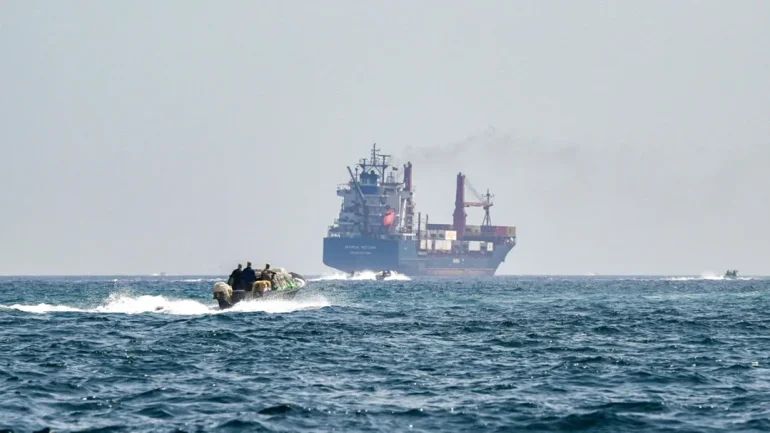
Iran seized two container ships in the Strait of Hormuz on Wednesday, escalating tensions in an already fragile ceasefire with the United States and its allies. The move came shortly after former President Donald Trump announced an extension of the ceasefire, giving Iran more time to present what he called a “unified proposal” for peace.
According to Iran’s Islamic Revolutionary Guard Corps (IRGC), the ships were taken for alleged maritime violations and escorted to Iranian waters. The incident marks the first such seizure since the U.S.-Israeli conflict with Iran began on February 28. Reports also indicate that at least three vessels in the area were fired upon, further raising concerns about safety in one of the world’s most critical shipping routes.
The Strait of Hormuz, located off Iran’s southern coast, is a vital artery for global energy supplies, with roughly one-fifth of the world’s oil and natural gas passing through it. Since the conflict intensified, traffic in the strait has dropped significantly, contributing to rising fuel costs. Gas prices in the United States climbed back above $4 per gallon this week, reflecting growing uncertainty in energy markets.
Despite the ceasefire extension, both sides continue to accuse each other of violations. Iranian officials have condemned the U.S. naval blockade of Iranian ports, calling it a “flagrant breach” of the agreement. Iran’s parliamentary speaker, Mohammad-Bagher Ghalibaf, argued that reopening the strait is “impossible” under current conditions and accused the U.S. of holding the global economy hostage.
Meanwhile, U.S. officials have defended the blockade as a necessary measure to limit Iran’s ability to fund terrorism. Senator Lindsey Graham voiced strong support for the strategy, suggesting the blockade could expand globally if Iran does not change course.
Military analysts say Iran’s ability to seize ships, even after suffering major naval losses, likely relies on smaller, fast-moving vessels. These speedboats, often armed with heavy weapons, can quickly approach and intimidate larger commercial ships, forcing compliance without the need for a full-scale naval operation.
Diplomatic efforts remain uncertain. Planned peace talks have been delayed, with Iranian officials saying they have not yet decided whether to participate. The U.S. delegation had been expected to travel to Pakistan for negotiations, but the trip was canceled following the ceasefire extension.
At the same time, international leaders are stepping in. Military officials from around 30 countries are set to meet in London to discuss strategies for reopening the Strait of Hormuz and restoring safe passage for global trade.
As the standoff continues, the economic pressure is mounting. Oil prices have climbed toward $100 per barrel, and analysts warn that the lack of progress in negotiations could push prices even higher.
Trump has repeatedly claimed that Iran is “collapsing financially,” alleging the country is losing hundreds of millions of dollars daily due to its inability to export oil. Iranian officials, however, have pushed back, accusing Washington of inconsistency and escalating the conflict through aggressive tactics.
With both sides holding firm and global markets feeling the strain, the situation in the Strait of Hormuz remains one of the most volatile and closely watched flashpoints in the world.