
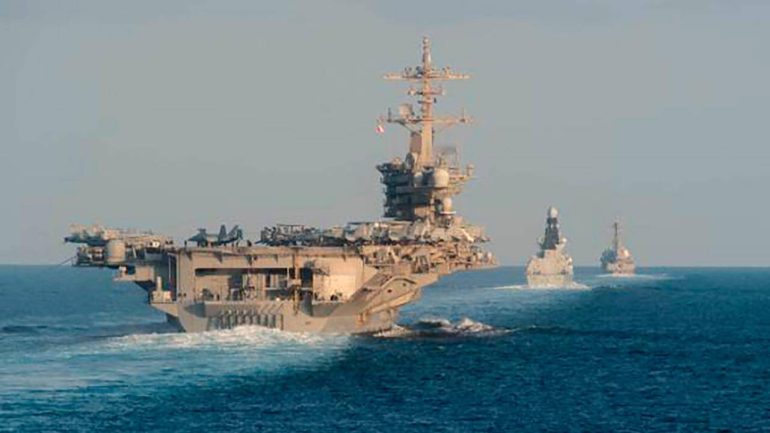
President Donald Trump said Saturday that the United States and several international partners plan to send warships to the Strait of Hormuz in an effort to reopen the critical shipping lane after recent attacks brought traffic in the region close to a halt.
The narrow waterway between the Persian Gulf and the Gulf of Oman is one of the world’s most important energy corridors. A large share of global oil exports passes through the strait each day, meaning disruptions there can quickly ripple across global markets.
In a post on Truth Social, Trump said “many countries” affected by Iran’s attempt to close the strait would join the United States in sending naval forces to keep the passage open.
“Many countries, especially those who are affected by Iran’s attempted closure of the Hormuz Strait, will be sending war ships, in conjunction with the United States of America, to keep the Strait open and safe,” Trump wrote.
He suggested that nations including China, France, Japan, South Korea and the United Kingdom could participate in the effort, though the White House has not confirmed which countries have formally agreed to deploy ships.
Shipping Disruptions Shake Energy Markets
Tensions around the strait have intensified after a series of attacks on vessels in the area. Officials say mines, drones, and anti-ship missiles have been used against commercial ships, severely disrupting traffic and driving concerns about global oil supplies.
Iran’s leader, Mojtaba Khamenei, reportedly ordered the waterway closed as long as the conflict with the United States continues. The closure has already contributed to rising prices for goods tied to energy costs, including fuel and fertilizer.
Trump claimed the U.S. military has already destroyed “100% of Iran’s military capability,” but acknowledged that smaller attacks — such as drone strikes or mines — can still threaten ships moving through the narrow channel.
U.S. Military Steps Up Presence
As the situation escalates, the Pentagon has begun sending additional forces to the region. Defense Secretary Pete Hegseth ordered the deployment of the amphibious assault ship USS Tripoli (LHA‑7) along with a Marine expeditionary unit to the Middle East.
The Marine force could carry out ground operations if ordered, although officials have not said whether that is being considered.
Meanwhile, U.S. forces launched a major strike Friday on Kharg Island, Iran’s main oil export hub. According to U.S. Central Command, the “large-scale precision strike” targeted naval mine storage facilities, missile bunkers and other military infrastructure. Roughly 90 military targets on the island were hit.
Trump said oil facilities themselves were not targeted in that attack but warned they could be struck if Iran continues attacking ships in the strait.
Risks of Escorting Ships
The idea of escorting commercial vessels through the strait has been discussed by U.S. officials in recent days. However, some military experts caution that the strategy carries risks.
Retired Rear Adm. John Kirby said drones and missiles can still threaten even heavily guarded ships.
“Drones can fly low and slow or fast and low, and they can do a lot of damage,” he said in a recent television interview.
Despite the dangers, Trump signaled the United States intends to act aggressively to restore shipping through the critical waterway.
“In the meantime, the United States will be bombing the hell out of the shoreline, and continually shooting Iranian boats and ships out of the water,” Trump wrote. “One way or the other, we will soon get the Hormuz Strait open, safe, and free.”