
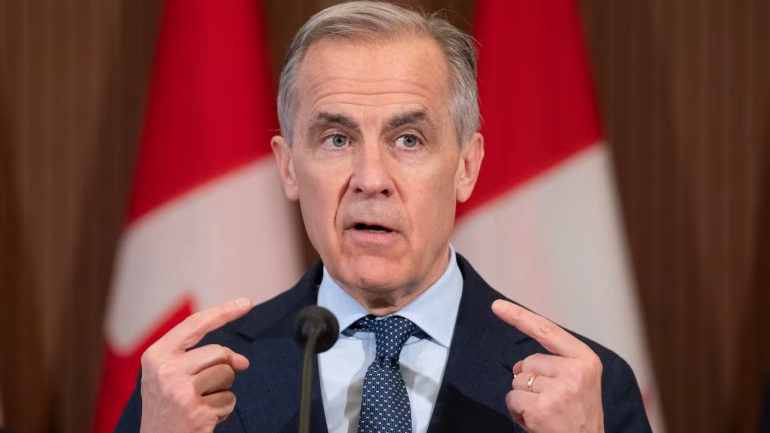
In a nearly 10-minute video address released on April 19, 2026, Canadian Prime Minister Mark Carney declared that Canada’s long-standing economic relationship with the United States, once a major source of strength, has now become a weakness that his government must fix.
Carney, a former central bank governor who led both the Bank of Canada and the Bank of England, spoke directly to Canadians about the need to adapt to a more dangerous and divided world. He pointed to changes in U.S. trade policy under President Donald Trump as the main reason for this shift.
“The world is more dangerous and divided,” Carney said. “The U.S. has fundamentally changed its approach to trade, raising its tariffs to levels last seen during the Great Depression. Many of our former strengths, based on our close ties to America, have become weaknesses—weaknesses that we must correct.”
The prime minister noted that American tariffs have hurt Canadian workers in key industries such as autos, steel, and lumber. He added that many businesses are delaying investments because of the uncertainty created by the ongoing trade tensions. Many Canadians have also reacted angrily to Trump’s suggestions that Canada could become the 51st U.S. state.
Carney promised to provide regular updates on his government’s efforts to reduce Canada’s dependence on the United States. His plan, which he called “Canada Strong,” focuses on attracting new investments from other countries, signing fresh trade deals, doubling clean energy capacity, lowering internal trade barriers within Canada, and making housing more affordable. He also highlighted recent increases in defense spending and tax reductions.
“We have to take care of ourselves because we can’t rely on one foreign partner,” Carney stated. “We can’t control the disruption coming from our neighbors. We can control what happens here. We can build a stronger country that can withstand disruptions from abroad.”
He rejected the idea of simply waiting for the United States to “return to normal,” calling it an unrealistic strategy. “Hope isn’t a plan and nostalgia is not a strategy,” he said.
Carney acknowledged Canada’s history as a loyal neighbor and ally, noting that Canada stood with the U.S. in two World Wars and the conflict in Afghanistan. However, he argued that the U.S. has changed and Canada must respond by taking greater control of its own security, borders, and economic future.
“Security can’t be achieved by ignoring the obvious or downplaying the very real threats that we Canadians face,” he added. “I promise you I will never sugarcoat our challenges.”
This is not the first time Carney has spoken about shifting global power dynamics. In January, during a speech at the World Economic Forum in Davos, Switzerland, he criticized economic coercion by larger powers against smaller countries and received international praise—though his comments drew a sharp rebuke from President Trump, who reminded Carney that “Canada lives because of the United States.”
Carney’s latest address comes shortly after his government secured a majority in special elections. At the same time, opposition Conservatives are pressing him to deliver on campaign promises, including reaching a new trade agreement with the U.S. A review of the North American Free Trade Agreement (now known as USMCA) between Canada, the United States, and Mexico is scheduled for July.
In the video, Carney emphasized that Canada has been a strong partner to the U.S. in the past, but it must now focus on building resilience at home. “The U.S. has changed and we must respond,” he concluded. “It’s about taking back control of our security, our borders and our future.”