
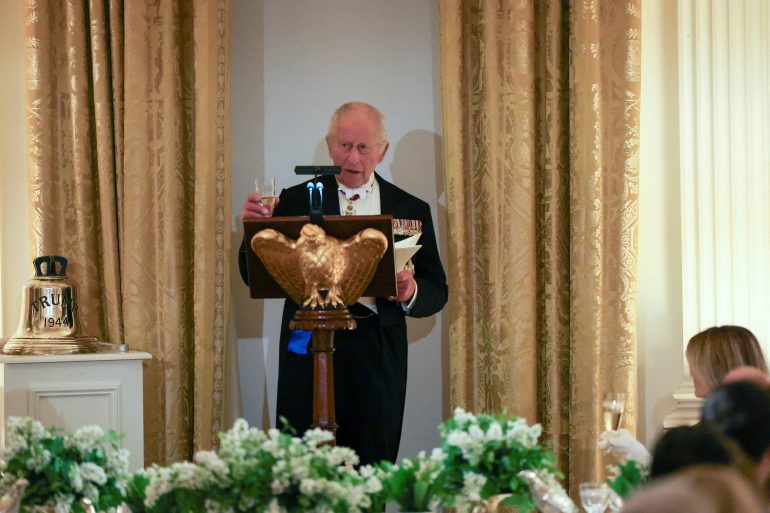
In a carefully balanced speech that mixed humor with serious reminders of duty, King Charles III addressed the U.S. Congress on Tuesday, gently pushing back against some of President Donald Trump’s recent positions while emphasizing the enduring importance of the U.S.-U.K. alliance.
The British monarch’s visit comes at a difficult time for relations between the two countries. Disagreements over the Iran war, NATO funding, support for Ukraine, and immigration policy have strained the traditionally close partnership. Despite these tensions, King Charles used both wit and history to reinforce the idea that the “special relationship” remains vital.
During his address to Congress, the king praised American leadership and the shared values that have long connected the two nations. He made several pointed but polite references to issues where he appeared to differ from Trump. Charles called for continued support for Ukraine and its “most courageous people,” highlighted the importance of NATO in protecting both North America and Europe, and stressed the need for inclusivity and international cooperation.
While the king’s speeches are officially written by the British government, aides say the tone and wording often reflect his personal input. His message was delivered with a light touch, including jokes about history and the shared English language, which helped the speech land well with lawmakers. The address received multiple standing ovations.
Later that evening, at a state dinner hosted by President Trump, King Charles continued his message. He spoke about the importance of checks and balances in government and expressed concern over the “disastrously melting icecaps of the Arctic,” topics that indirectly challenged some of Trump’s views on executive power and climate change.
In one notable moment, Trump claimed during his toast that the king agreed with him strongly on preventing Iran from obtaining nuclear weapons. Buckingham Palace responded carefully, noting that the king supports the long-standing British position against nuclear proliferation.
The king also presented President Trump with a symbolic gift: the original bell from the HMS Trump, a British submarine launched in 1944 during World War II. The gesture served as a reminder of the deep military cooperation between the two countries in the past.
Charles repeatedly invoked America’s role in rebuilding Europe after World War II and drew parallels to the current situation in Ukraine, where Russia’s invasion has once again put freedom under threat. He noted that while the U.S. has stopped direct military aid to Ukraine under the Trump administration, it continues to provide intelligence support.
Analysts say the king’s unique position as a constitutional monarch allowed him to deliver these messages in a way that felt diplomatic rather than confrontational. Michael Bociurkiw, a senior fellow at the Atlantic Council, observed that Charles may be “the only world figure” who could visit the White House at such a turbulent time and politely say what needed to be said without causing offense.
However, Bociurkiw doubted the speech’s long-term impact, predicting that its message might be quickly forgotten amid ongoing political pressures.
On Wednesday, King Charles travels to New York, where he is scheduled to visit the 9/11 memorial. There, the tone is expected to shift from light-hearted diplomacy to solemn reflection. He is also expected to meet with New York City Mayor Zohran Mamdani.
Throughout his visit, King Charles has tried to walk a delicate line — honoring the historic friendship between the United States and Britain while quietly reminding both nations of their shared obligations in an increasingly uncertain world.