
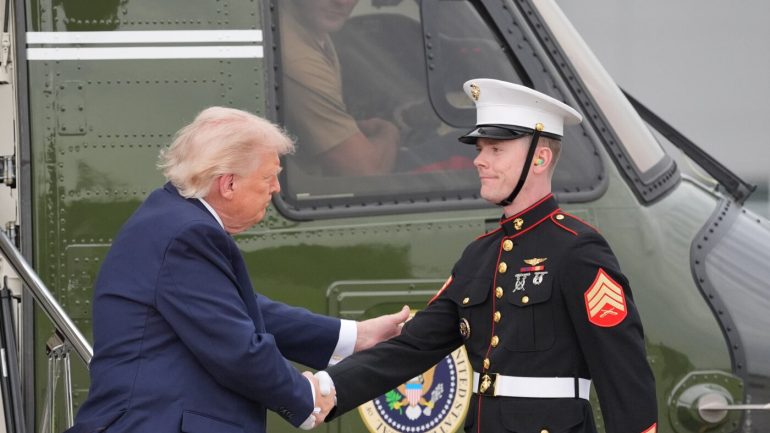
President Donald Trump is scheduled to visit Walter Reed National Military Medical Center on Tuesday for what the White House calls a “routine annual dental and medical assessment.” This will be Trump’s third trip to the military hospital in just 13 months, sparking fresh questions about the 80-year-old president’s health.
Trump, who will turn 80 in June, is the oldest person ever elected to a second term as president. His age, along with visible signs such as swollen ankles and bruised hands, has led to ongoing public concern. The White House announced the appointment two weeks ago, describing it as part of Trump’s regular preventive care.
Recent Medical Visits Raise Questions
Trump’s last full physical exam took place in April 2025. Afterward, the White House released a memo saying he was in “excellent health,” and Trump told reporters he had “aced” his cognitive test. A few months later, in October 2025, he returned to Walter Reed for a scheduled follow-up. Then in December, the White House revealed he had undergone a CT scan to check his cardiovascular and abdominal health. White House physician Capt. Sean Barbabella has repeatedly stated that the president remains in excellent overall health.
Despite these assurances, footage of Trump has sometimes shown makeup covering bruises on his hands and moments of visible tiredness. In January, Trump told the Wall Street Journal he regretted the October CT scan because it fueled speculation. He attributed the bruising on his hands to taking too much aspirin.
Trump’s Health History
The president has a mixed record of sharing detailed medical information. The most recent public report from April 2025 noted a few issues: scarring on his right ear from the 2024 assassination attempt in Butler, Pennsylvania, and diverticulosis with a benign polyp found during a colonoscopy. Doctors recommended another colonoscopy in three years.
That report also showed Trump weighed 224 pounds — 20 pounds less than in 2020 — and had healthy “bad” cholesterol levels. In summer 2025, he was diagnosed with chronic venous insufficiency, a condition that affects blood flow in the veins and can cause leg swelling. The White House said his overall cardiovascular health was still excellent.
Trump’s former doctor, Rep. Ronny Jackson, has given positive assessments of the president’s health in the past, including after the 2024 assassination attempt.
Comparisons to Biden and Campaign Rhetoric
During the 2024 campaign, Trump frequently criticized then-President Joe Biden’s age and mental sharpness, calling him “Sleepy Joe.” Biden’s visible decline and poor debate performance played a major role in his decision to drop out of the race. Now, with Trump in office, the White House strongly defends the president’s energy, pointing to his busy schedule and recent diplomatic efforts, such as negotiations on a U.S.-Iran peace deal.
White House Communications Director Steven Cheung highlighted Trump’s long workdays on social media, writing, “This man is focused and determined. Can’t stop, won’t stop.” Health and Human Services Secretary Robert F. Kennedy Jr. also noted in a January interview that Trump has exceptionally high testosterone levels for a man over 70.
Expert Perspective
Dr. Byron Lee, a professor of cardiovascular medicine at Stanford University, told NPR that annual physicals are common and sensible for someone Trump’s age. He noted that staying active with a demanding schedule can actually be good for older adults. However, Dr. Lee said he would like more information about Trump’s aspirin use, which can cause bruising, and his chronic venous insufficiency, which may signal other issues.
“He is a little overweight, and those are things that put you at high risk for heart disease,” Lee said. He added that continuing to lose weight and remain active would be positive steps, and mentioned that medications like GLP-1 drugs (such as Ozempic) are now commonly prescribed for patients in Trump’s age and weight range.
The White House did not provide additional details about Tuesday’s visit beyond its original announcement. As Trump continues his second term, questions about his long-term health are likely to remain a focus for the public and the press.