
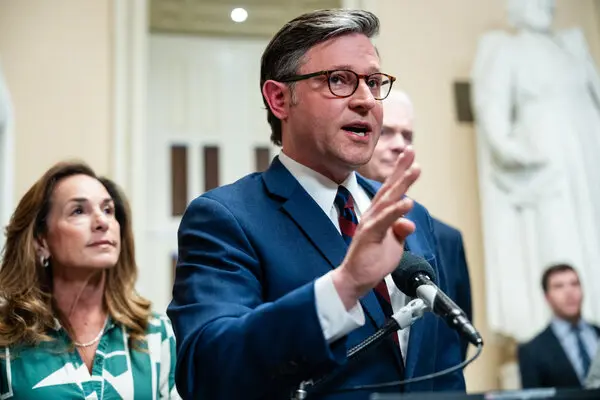
House Speaker Mike Johnson announced Friday that House Republicans will not accept a Senate-passed spending bill that funds most of the Department of Homeland Security (DHS) but leaves out key immigration enforcement agencies. The ongoing partial shutdown of DHS has dragged on for more than a month, causing major problems at airports and leaving thousands of federal workers without pay during the busy spring break travel season.
The Senate bill, which passed early Friday morning by voice vote, would provide money for agencies like the Transportation Security Administration (TSA), the Coast Guard, and the Federal Emergency Management Agency (FEMA). However, it excludes additional funding for Immigration and Customs Enforcement (ICE) and Border Patrol. It also does not include any new limits on immigration officers’ tactics that Democrats had demanded.
Johnson, a Republican from Louisiana, called the Senate’s approach “a joke” and a political “gambit.” Speaking to reporters at the Capitol, he said the House would instead vote on its own short-term bill to fully fund the entire Department of Homeland Security through May 22.
“I spoke to the president a few moments ago, he understands exactly what we’re doing and why. And he supports it,” Johnson said. He added that he expects the House to pass the stopgap measure quickly, but it remains unclear whether the Senate—where many Democrats have left town—would approve it. Senate Democrats have said they will not support any bill that funds ICE.
The funding impasse stems from deep disagreements over immigration policy. For weeks, Democrats have blocked full DHS funding after federal officers were involved in the deaths of two U.S. citizens in Minneapolis. Senate Minority Leader Chuck Schumer praised his party’s unity, saying Democrats “held the line” against giving more money to what he called “Donald Trump’s rogue and deadly militia” without serious reforms.
Republicans, however, accused Democrats of using the shutdown for political gain rather than seeking a real solution. Senate Majority Leader John Thune said Democrats had refused even small efforts to negotiate and seemed more interested in creating an issue than fixing the problem.
The shutdown has taken a real toll. Tens of thousands of DHS employees have been working without pay or have quit. TSA wait times have grown longer at some airports. Ha Nguyen McNeill, the acting TSA administrator, told lawmakers earlier in the week that officer absences have reached as high as 40 percent at certain airports, and more than 480 TSA workers have left their jobs during the shutdown. She warned about the long-term damage to the agency’s workforce and security efforts.
To ease the airport backups in the short term, President Trump signed a memo on Friday directing the use of executive action to pay TSA agents. The move aims to keep screening operations running smoothly, though questions remain about where the funding will come from and whether it is fully legal.
Some parts of DHS, such as ICE, have been able to keep operating thanks to roughly $75 billion provided earlier through the One Big Beautiful Bill Act passed by Republicans last summer. Other agencies have relied on unpaid workers to continue their missions.
All week, top Republicans pushed back against splitting up DHS funding. Negotiations in the Senate continued late into the night Thursday as lawmakers tried to find common ground. President Trump had earlier called for including his proposed voting law changes, known as the Save America Act, in any deal.
By Friday, Johnson made it clear the House would not go along with the Senate’s partial approach. House Republicans met and rejected the plan, setting up a potential standoff between the two chambers. While some Democrats in the Senate appeared open to compromise, worries persisted on both sides about how the money would actually be used.
As the shutdown enters its second month, the pressure is mounting. Travelers face delays, federal workers are struggling financially, and national security operations are strained. Lawmakers on both sides say they want a solution, but sharp differences over immigration enforcement continue to block agreement. For now, the House plans to move forward with its own full-funding stopgap, leaving the next steps up to the Senate.