
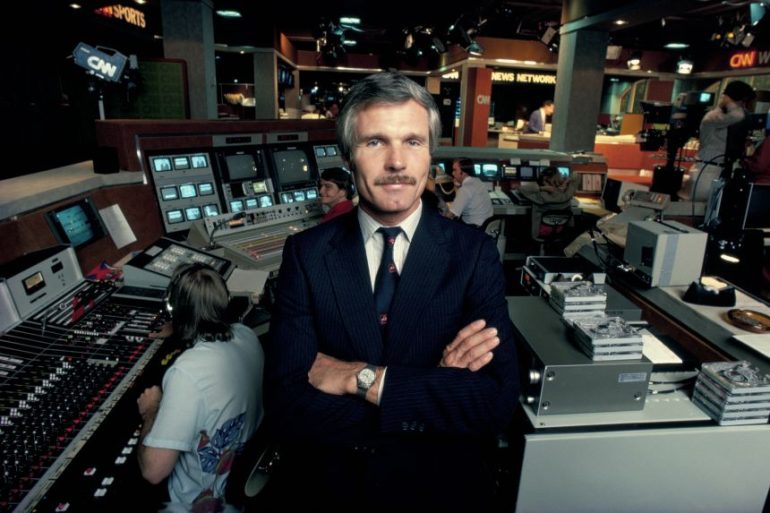
Ted Turner, the bold and unconventional media mogul who reshaped television forever by launching the first 24-hour news network, has died at the age of 87. Turner passed away at his home near Tallahassee, Florida, after previously revealing he had been diagnosed with Lewy body dementia, a progressive neurological disorder.
Turner’s most lasting legacy is CNN, the Cable News Network, which he founded in 1980. At a time when news was limited to scheduled broadcasts, Turner introduced a radical idea: news that never stopped. CNN’s around-the-clock coverage transformed how people consumed information, offering live updates as events unfolded and eventually becoming a model followed across the media world.
But CNN was only part of Turner’s sweeping influence. Over the years, he built a sprawling media empire that included CNN Headline News, CNN International, and the pioneering “superstation” TBS, along with TNT. He later expanded into entertainment by acquiring major film libraries and launching Turner Classic Movies. His purchase of Hanna-Barbera cartoons led to the creation of Cartoon Network in 1992, bringing iconic animated characters to a new generation.
Turner’s career was defined by bold risks that often pushed him to the brink of financial collapse. In the 1970s, he bought a struggling Atlanta television station and turned it into a national powerhouse using satellite broadcasting—an idea many thought was too risky. He also purchased the Atlanta Braves baseball team and broadcast their games nationwide, helping to boost both the team’s popularity and his network’s reach.
Despite early skepticism, Turner’s gambles paid off. By the 1990s, his ventures had grown into a multibillion-dollar empire. In 1996, he merged Turner Broadcasting with Time Warner, creating one of the largest media companies in the world.
Outside of business, Turner lived an equally dramatic life. He was an accomplished yachtsman, winning the prestigious America’s Cup in 1977. His personal life, however, was often turbulent, marked by high-profile marriages—including one to actress Jane Fonda—and a reputation for brash behavior and outspoken remarks.
Turner was also known for his contradictions. He identified as a conservative at times but supported global causes often associated with more liberal views. In one of his most notable philanthropic acts, he pledged $1 billion to the United Nations. He was also a major landowner and environmental advocate, setting aside vast areas as protected wilderness.
His impact on journalism cannot be overstated. CNN’s real-time reporting during major global events—from the fall of the Berlin Wall to the Gulf War—helped define modern news coverage. By delivering information instantly rather than on a fixed schedule, Turner fundamentally changed the relationship between the public and current events.
“I’ve always been more of an adventurer than a businessman,” Turner once said. That spirit of risk-taking and ambition defined his life, driving him to challenge industries, defy expectations, and leave a permanent mark on global media.
Ted Turner is survived by his children, grandchildren, and great-grandchildren. His legacy lives on in the nonstop flow of news that has become a central part of modern life—a world he helped create