
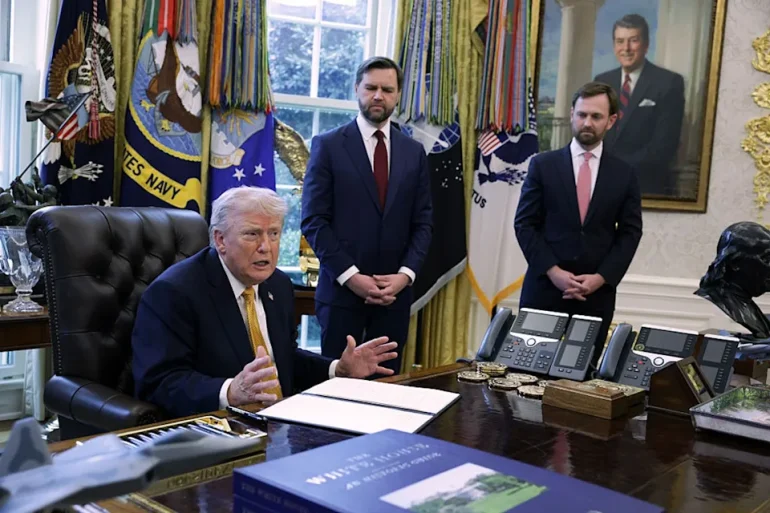
President Donald Trump sparked controversy this week after suggesting he could “take” Cuba and do “anything” he wanted with the island nation, remarks that came during an already tense period of global conflict.
Speaking to reporters during an executive order signing ceremony, Trump described Cuba as a “failed state” and hinted that it could become a future target of U.S. action following the ongoing conflict with Iran. He said he might have the “honor” of taking Cuba “in some form,” adding, “whether I free it, or take it… I think I can do anything I want with it.”
The comments immediately drew attention due to their sweeping nature and lack of clarity. When pressed by reporters to explain what “taking” Cuba would mean, Trump did not provide specifics, leaving open questions about whether he was referring to military action, political intervention, or rhetorical posturing.
His remarks echo recent statements from Lindsey Graham, a Republican ally who has strongly supported the administration’s military campaign against Iran. Graham recently suggested that Cuba could be next on a list of governments the U.S. might confront, calling the country’s leadership a “communist dictatorship” and warning that its “days are numbered.”
The president’s comments come as the U.S. continues its military campaign against Iran, now in its third week. The conflict has resulted in hundreds of deaths, including 13 American service members, and has raised concerns about broader regional instability. At the same time, administration officials have offered few details about the operation’s long-term goals, even as Trump has repeatedly claimed that an end to the fighting is near.
The war has also had global economic consequences. Iran’s efforts to disrupt shipping in the strategically vital Strait of Hormuz—a route through which roughly 20 percent of the world’s oil supply passes—have driven up energy prices and heightened fears of a wider economic impact.
Against this backdrop, Trump’s comments about Cuba have revived memories of a long and complicated history between the two countries. Relations have been strained for decades, shaped by Cold War tensions and events like the Cuban Missile Crisis, when the world came close to nuclear confrontation.
In more recent years, the U.S. briefly moved toward normalization under Barack Obama, who sought to ease restrictions and reopen diplomatic ties with Cuba. That policy shift was controversial and was later reversed during Trump’s first term, restoring a tougher stance toward the Cuban government.
While Trump’s latest comments stop short of outlining a concrete policy, they underscore the uncertainty surrounding U.S. foreign policy at a time of escalating global tensions. Whether his remarks signal a serious shift in strategy or are simply rhetorical remains unclear, but they have already intensified debate over America’s role on the world stage.