
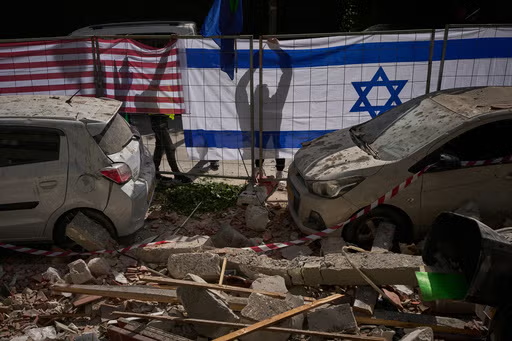
Iran sharply escalated its military campaign on Thursday, launching a series of strikes against oil and natural gas facilities across the Persian Gulf. The attacks, which set key energy sites in Qatar and Kuwait ablaze, mark a dangerous new phase in the war and have already sent global fuel prices surging.
The strikes came in retaliation for an Israeli attack on Iran’s most important gas field, South Pars. That move appears to have triggered a broader strategy by Iran to target the region’s energy infrastructure—an approach that threatens not only its immediate neighbors but also the global economy.
Energy markets reacted swiftly. Brent crude oil briefly climbed above $119 per barrel, a sharp increase of more than 60% since the war began in late February. Natural gas prices in Europe have also surged, roughly doubling over the past month as supply concerns deepen.
Much of the tension centers on the Strait of Hormuz, a narrow but critical shipping route through which about one-fifth of the world’s oil passes. Iran’s ability to disrupt traffic in the strait, combined with direct attacks on production facilities, has created a severe bottleneck in global energy supply.
The damage across the Gulf has been widespread. Qatar reported significant destruction at its Ras Laffan liquefied natural gas facility, a key hub for global exports. In Saudi Arabia, a refinery in the Red Sea city of Yanbu was struck by an Iranian drone, undermining efforts to bypass the Strait of Hormuz by rerouting oil shipments westward. Additional strikes hit oil refineries in Kuwait and gas operations in Abu Dhabi.
Shipping in the region has also come under threat. One vessel was set on fire off the coast of the United Arab Emirates, while another was damaged near Qatar, highlighting the growing risks to maritime trade.
Leaders across the Arab world have condemned the attacks. Saudi Arabia’s foreign minister warned that the strikes highlight the increasing danger to countries not directly involved in the conflict, calling for an immediate halt to the escalation. Regional officials fear that continued attacks could pull more nations into the war.
Despite heavy losses earlier in the conflict—including the deaths of top leaders and significant damage to its military—Iran has continued to demonstrate its ability to strike back. Missile and drone attacks have reached deep into neighboring countries and even into Israel, where repeated barrages have forced millions of civilians into shelters.
In Washington, U.S. Defense Secretary Pete Hegseth signaled that the conflict could intensify further. He suggested that additional Iranian leaders may be targeted, particularly within the powerful Revolutionary Guard and its affiliated forces. He also drew a contrast between the current war and past U.S. conflicts, criticizing earlier military campaigns in Iraq and Afghanistan.
Meanwhile, the financial cost of the war continues to rise. The Pentagon is reportedly seeking an additional $200 billion in funding, underscoring the scale and complexity of the conflict.
The broader humanitarian toll is also mounting. More than 1,300 people have been killed in Iran, while Israeli strikes in Lebanon have displaced over one million people. Casualties have also been reported in Israel, the West Bank, and among U.S. forces.
At the center of the latest escalation is the battle over energy infrastructure. By striking South Pars, Israel directly threatened Iran’s main source of power generation, as the country relies heavily on natural gas for electricity and daily life. Iran’s response—targeting Gulf energy facilities—appears designed to impose similar economic and civilian pressure on its adversaries.
Iranian President Masoud Pezeshkian warned that the conflict could spiral beyond control, with consequences that might “engulf the entire world.” That warning is increasingly being taken seriously, as attacks on energy supplies ripple through global markets and raise fears of a broader regional war.
With neither side showing signs of backing down, the situation remains volatile. As energy infrastructure becomes a central battlefield, the risks now extend far beyond the Middle East—touching economies and consumers around the world.