
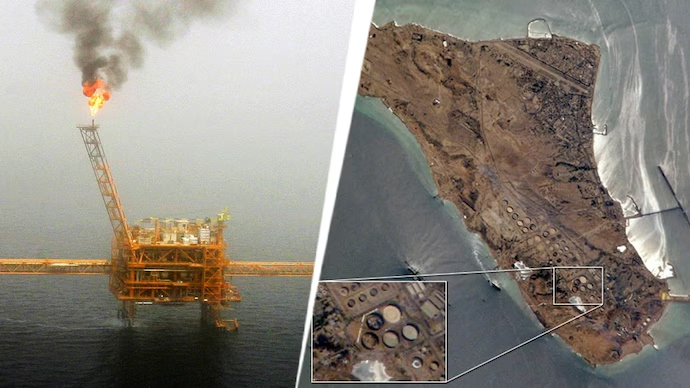
As the war with Iran enters a dangerous new phase, President Donald Trump is reportedly considering a bold—and risky—strategy: taking control of Kharg Island, the heart of Iran’s oil export system, in an effort to force Tehran to reopen the Strait of Hormuz.
According to multiple sources familiar with internal discussions, the Trump administration is exploring options that include either occupying the island with U.S. troops or imposing a naval blockade to cut off access. Kharg Island, located just 15 miles off Iran’s coast, handles roughly 90% of the country’s crude oil exports, making it one of the most strategically valuable energy sites in the region.
The stakes are high. Iran’s effective closure of the Strait of Hormuz—a critical passageway for global oil shipments—has already driven energy prices sharply upward and rattled international markets. For Trump, reopening the strait is seen as essential to ending the conflict on favorable terms.
But seizing Kharg Island could significantly escalate the war. U.S. officials acknowledge that such an operation would place American troops directly in harm’s way and likely require a substantial military buildup. Three Marine units are already heading to the region, with additional reinforcements under consideration.
One source described the emerging strategy bluntly: weaken Iran’s defenses through sustained airstrikes, then move in to capture the island and use it as leverage in negotiations. The U.S. military has already conducted large-scale strikes on Kharg Island, targeting infrastructure and defenses while deliberately leaving oil pipelines intact—potentially preserving their value for future use.
Publicly, the administration has kept its options open. A senior official said Trump is determined to reopen the strait “one way or another,” but emphasized that no final decision has been made. Trump himself has sent mixed signals, saying he is not planning to deploy ground troops—while also noting that he wouldn’t reveal such plans if he were.
Supporters of a tougher approach, including Tom Cotton, argue that keeping all military options on the table is a sign of strategic caution. Cotton described Iran’s move to restrict the strait as an act of desperation and suggested the administration has numerous contingency plans.
Still, some military experts warn that capturing Kharg Island may not achieve the desired outcome. Retired Rear Admiral Mark Montgomery cautioned that Iran could simply respond by halting oil production elsewhere, limiting the strategic benefit while increasing risks to U.S. forces.
An alternative approach under consideration would avoid a ground invasion altogether. Instead, the U.S. could intensify strikes on Iranian military assets and deploy naval forces to escort oil tankers through the strait, effectively bypassing Iran’s blockade.
Behind the scenes, legal questions are also being weighed. Pentagon lawyers have reportedly been consulted on the legality of both a military occupation and a naval blockade, underscoring the complexity of the potential move.
The situation has already disrupted Trump’s broader agenda. Plans for a diplomatic trip to China have been postponed as the conflict drags on, now entering its third week with no clear end in sight.
As fighting intensifies across the region and attacks on energy infrastructure spread, the decision over Kharg Island could mark a turning point—either forcing a breakthrough or pushing the war into even more dangerous territory.