
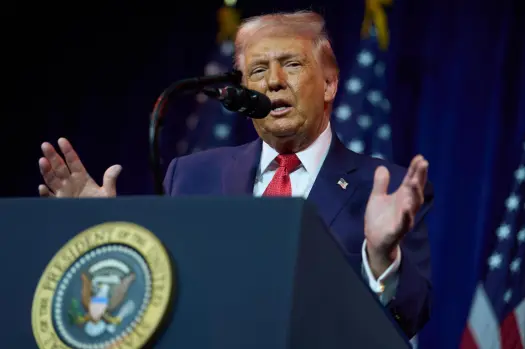
President Donald Trump unveiled his fiscal year 2027 budget on Friday, calling for a record $1.5 trillion in defense spending while proposing significant reductions in many domestic programs. The plan reflects the administration’s strong focus on national security and military strength, especially during the ongoing U.S.-led conflict with Iran.
The proposed defense budget represents roughly a 44% increase over current levels and would be one of the largest in decades. According to Budget Director Russell Vought, the increase fulfills Trump’s promise to strengthen America’s national security in a “dangerous world.” The White House highlighted plans to expand munitions supplies, grow the naval fleet, begin work on a new “Golden Dome” missile defense system, and provide 5% to 7% pay raises for military personnel to improve recruitment and retention.
Of the $445 billion in additional defense funding, the administration wants $350 billion to pass through budget reconciliation — a process that allows approval with only a simple majority in the Senate, bypassing the need for Democratic support.
Priorities in Immigration, Justice, and Infrastructure
The budget also directs resources toward key Trump administration goals outside of traditional defense:
- Immigration enforcement: It supports expanded deportation operations by maintaining funding for Immigration and Customs Enforcement (ICE), using prior increases for the Department of Homeland Security to add detention capacity (including 100,000 adult beds and 30,000 family beds), and eliminating certain refugee resettlement aid programs.
- Justice Department: A 13% funding increase aimed at targeting violent crime and what the administration calls “migrant crime.”
- Aviation and parks: An additional $481 million to hire more air traffic controllers and improve aviation safety, plus a new $10 billion fund for construction and beautification projects in and around Washington, D.C., within the National Park Service.
Sharp Reductions in Domestic and “Woke” Programs
On the domestic side, the proposal calls for a 10% overall cut in non-defense spending — about $73 billion — with many reductions aimed at programs the administration labels as “woke.” The word “woke” appears 34 times in the 92-page document.
Specific cuts include:
- Elimination of the $4 billion Low Income Home Energy Assistance Program.
- Cuts to the Community Services Block Grant, which provides job counseling, financial assistance, and housing help. The administration claims some grants have been “hijacked by radicals” to push equity and green energy initiatives.
- A $106 million reduction at the Agency for Healthcare Research and Quality, which the White House accuses of promoting “radical gender ideology” to children.
- Major reductions at the Department of Agriculture (19%), Housing and Urban Development (13%), and Health and Human Services (about 12%).
- Cancellation of more than $15 billion from Biden-era infrastructure law funding for renewable energy projects, along with deep cuts to environmental programs at the EPA (cut in half), NOAA, and the Department of Energy’s climate research.
The plan also proposes reorganizing or cutting parts of FEMA and the Cybersecurity and Infrastructure Security Agency, and begins steps toward privatizing some TSA airport screening roles at smaller airports. Funding for the National Institutes of Health would drop by $5 billion, and the IRS would lose another $1.4 billion.
Reactions from Both Sides
Republican leaders on the House and Senate Armed Services committees praised the defense increase. Sen. Roger Wicker of Mississippi and Rep. Mike Rogers of Alabama said the funding is necessary because “America is facing the most dangerous global environment since World War II,” citing threats from China, Russia, and Iran.
Democrats strongly criticized the plan. Rep. Brendan Boyle of Pennsylvania called it “America Last,” arguing that it pours resources into the military while slashing support for health care, housing, and other essential services. Sen. Patty Murray of Washington labeled the budget “morally bankrupt,” contrasting Trump’s priorities (including a proposed White House ballroom renovation) with the need for more affordable housing.
Context of Debt, Deficits, and Congressional Reality
The budget arrives as the federal government faces nearly $2 trillion in annual deficits and a national debt exceeding $39 trillion. About two-thirds of annual federal spending is tied up in mandatory programs like Social Security, Medicare, and Medicaid, which continue to grow with an aging population. The remaining discretionary spending — split between defense and domestic programs — is where most political battles occur.
Trump’s budget is largely symbolic. It does not have the force of law, and Congress has the final say on spending. In the past, lawmakers have often ignored large parts of presidential budget proposals. Last year, when Trump sought even deeper cuts to non-defense programs (about 20%), Congress largely kept spending flat.
The proposal comes amid ongoing fights in Congress over current-year (2026) spending and a record 49-day partial government shutdown affecting the Department of Homeland Security. Trump announced Thursday he would use an executive order to ensure pay for affected DHS workers.
While the White House is counting on Republican majorities to advance much of the defense increase through reconciliation and regular appropriations, Democrats have already signaled strong opposition, setting up what is likely to be a contentious budget season in Washington.