
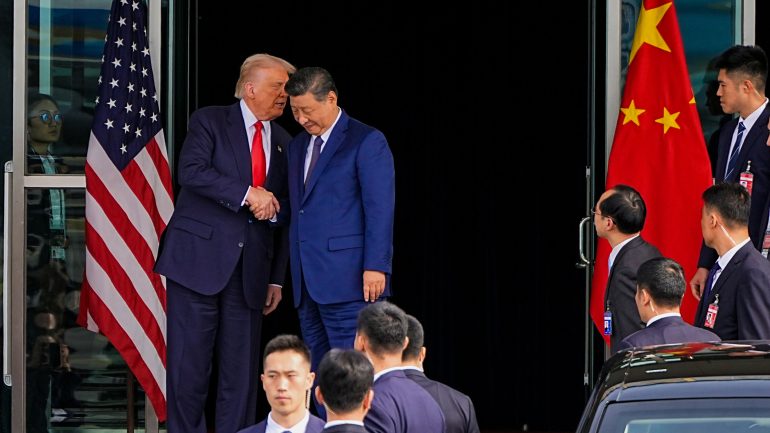
Chinese President Xi Jinping will host U.S. President Donald Trump in Beijing this week for the first time since Trump’s 2017 visit. The atmosphere this time is very different. Nine years ago, Trump received a grand welcome with children waving flags and Chinese officials hoping to strike deals with a leader they saw as a practical businessman. Today, China is far stronger and more confident, and Xi understands Trump’s unpredictable style. Beijing is not expecting major long-term agreements.
Instead, Xi aims to present China as a stable and responsible global power compared to U.S. unpredictability, according to experts from both countries. China’s economy, technology, and influence have grown significantly since 2017. Xi has strengthened his control over the Communist Party, secured a third term, and poured resources into artificial intelligence, manufacturing, and green energy.
The summit was delayed from March because of the ongoing war in Iran. That conflict has hurt Trump’s image at home and abroad due to its high costs and damage to the global economy. As the leaders of the world’s two largest economies meet, both sides want to ease tensions after months of tariffs, export controls, and U.S. sanctions on Chinese companies linked to Iran.
A More Assertive China
Since Trump returned to the White House, Xi has shown he is willing to push back. China has responded to tariff threats with its own measures but has also negotiated mutual steps to reduce conflict. Chinese analysts say Beijing now has more experience dealing with Trump and feels clearer about its own goals.
“China’s comprehensive national power has grown significantly since 2017,” said William Klein, a former U.S. Embassy official in Beijing who helped arrange the 2017 visit.
One clear example came late last year when China used its near-monopoly on rare earth minerals. In response to U.S. tariffs, Beijing imposed export controls on these critical materials used in advanced technology. The move helped lead to a trade truce. Former Trump officials say China realized that constantly giving in to threats would only invite more pressure.
China has also blocked some U.S. sanctions on its companies. In February, the U.S. Supreme Court struck down many of Trump’s high tariffs on Chinese goods, handing Beijing another victory.
Concerns Over Taiwan and Regional Power
U.S. allies in Asia are watching closely. Some worry Xi may press Trump for concessions on Taiwan. China claims Taiwan as its territory, though it has never ruled the island. The long war in Iran has stretched U.S. military resources, raising fears in Taiwan and Japan about America’s ability to respond quickly if China acted against Taiwan.
Chinese analysts note that Trump has not been as confrontational on Taiwan as previous leaders. Xi may try to push the U.S. to go beyond simply “acknowledging” Beijing’s position and actually recognize it.
Limited Expectations for This Summit
Unlike the 2017 visit — which included a private tour of the Forbidden City, performances, and a lavish banquet — expectations are much lower now. Trump is heavily focused on the Iran war, and there has been less detailed preparation than in the past. Chinese officials have expressed frustration over the lack of senior-level planning meetings.
Still, a reasonably successful meeting matters to both leaders. Xi needs to show he can manage relations with the United States to keep support at home and help China’s economy recover. China is facing a slowdown, with weak consumer spending and problems in its property market. In March, the government set its lowest economic growth target in decades.
Beijing also wants to protect its interests in the Middle East and avoid being pulled into the Iran conflict. Chinese leaders have recently emphasized the need for better energy security.
A Symbolic Opportunity
Despite the challenges, Chinese experts see 2026 as an important year for U.S.-China ties, with up to four meetings possible between Xi and Trump. For Xi, the summit offers a chance to show that relations are stabilizing and that China is improving its business environment to attract foreign trade and investment.
Out of all countries, the United States has the greatest impact on China’s security and development, said Wang Yiwei, a former Chinese diplomat. For that reason, China has a strong interest in preventing ties from getting worse.
Xi enters the meeting with a stronger hand than in 2017, but he also faces pressure to deliver stability. Trump remains unpredictable. The summit will test whether the world’s two biggest powers can manage their rivalry without letting it spiral out of control