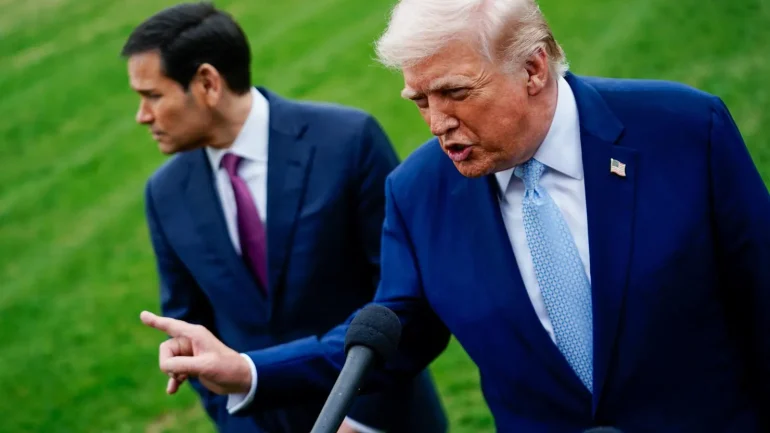
President Donald Trump issued a strong warning to Iran on Saturday, stating that “all hell will reign down” on the country if it fails to open the Strait of Hormuz within 48 hours.
The ultimatum comes as Trump’s original 10-day deadline for Iran to reach a deal or reopen the vital waterway is set to expire on Monday. In earlier statements, Trump had threatened to bomb Iran’s energy, water, and oil infrastructure if no agreement was made.
The Strait of Hormuz is a narrow passage in the Persian Gulf through which a large portion of the world’s oil supply travels. Closing or restricting it has raised concerns about global energy prices and supply disruptions.
Why the Threat Matters
Trump’s latest message on Truth Social repeated his earlier warning: “Remember when I gave Iran ten days to MAKE A DEAL or OPEN UP THE HORMUZ STRAIT. Time is running out — 48 hours before all Hell will reign down on them.”
Iran has pushed back strongly, accusing the United States of planning actions that could amount to war crimes. Over the past ten days, the two sides have engaged in indirect talks through mediators from Pakistan, Egypt, and Turkey. The goal has been to arrange a ceasefire in exchange for Iran reopening the strait. So far, those efforts have produced little progress.
Reactions from U.S. Officials
Senator Lindsey Graham (R-South Carolina) said he spoke with Trump on Saturday about the situation. Graham expressed full confidence in the president’s resolve.
“After speaking with President Trump, I am completely convinced that he will use overwhelming military force against the regime if they continue to impede the Strait of Hormuz and refuse a diplomatic solution,” Graham wrote on X. He added that it should now be clear to Iran and others that “President Trump means what he says.”
Behind-the-Scenes Negotiations
The indirect discussions have involved high-level figures on both sides. Vice President JD Vance and Iran’s Speaker of Parliament Mohammad Bagher Ghalibaf have played key roles, with Pakistan’s military chief, Field Marshal Asim Munir, helping to mediate. White House envoy Steve Witkoff and the foreign ministers of Iran, Pakistan, Turkey, and Egypt have also taken part.
Sources familiar with the talks say mediators are still pushing for the two sides to meet directly. However, Iran has so far rejected ideas for a temporary ceasefire. Instead, Iranian officials are demanding a permanent end to the conflict along with firm guarantees that the U.S. will not launch future attacks.
As the Monday deadline approaches, mediators are exploring confidence-building steps that could lead to face-to-face negotiations. It remains uncertain whether any agreement can be reached in time to avoid escalation.
The situation continues to develop quickly, with global attention focused on whether diplomacy can succeed before Trump’s deadline passes.