
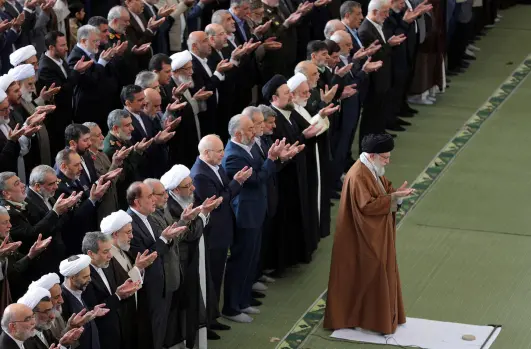
Ayatollah Ali Khamenei, Iran’s supreme leader for nearly 37 years, was killed in a U.S.-Israeli airstrike campaign, Iranian state media confirmed on March 1, 2026. His death at age 86 leaves the Islamic Republic facing one of its biggest tests since the 1979 revolution. For the first time since Ayatollah Ruhollah Khomeini died in 1989, Iran must choose a new supreme leader while the country is under attack and dealing with protests at home.
Temporary Leadership Takes Over
Iran’s constitution calls for a Provisional Leadership Council to step in right away. This three-person group includes:
- Reformist President Masoud Pezeshkian,
- Hard-line judiciary chief Gholamhossein Mohseni Ejei,
- One cleric from the Guardian Council, picked by the Expediency Council.
The council will handle all leadership duties until a permanent successor is named. The regular armed forces and the powerful Islamic Revolutionary Guard Corps (IRGC) will keep operating under their current commanders.
How a New Supreme Leader Is Chosen
The final decision rests with the Assembly of Experts, an 88-member body of Shiite clerics. These clerics are elected by the public every eight years, but the Guardian Council must approve every candidate first. That council often blocks anyone seen as too moderate or disloyal. For example, it disqualified former President Hassan Rouhani from running for the Assembly in 2024.
The Assembly must meet “as soon as possible” to pick the new leader. The person chosen must be a male Shiite cleric with political skill, moral standing, and loyalty to the Islamic Republic. Since a 1989 constitutional change, the leader no longer has to hold the highest religious rank of Grand Ayatollah. The Assembly could also decide to name a small council of clerics instead of one person, though that has never been tried.
Everything happens behind closed doors. The public and even most Iranians have no say in the final choice.
The IRGC’s Hidden Power
While clerics run the formal process, the IRGC—the country’s most powerful military and economic force—has the real influence. The Guard controls huge businesses, runs intelligence operations, and leads the “Axis of Resistance,” a network of militant groups fighting the United States and Israel across the Middle East. Any new supreme leader will need the IRGC’s strong support to stay in control, especially during wartime.
Who Are the Main Candidates?
No one has been officially named, and talks are secret. Here are the leading names being discussed:
- Mojtaba Khamenei, 56, the late leader’s second son. He is a cleric with close ties to the IRGC and the Basij militia. He has never held public office, and some experts say the Assembly quietly removed him from its shortlist last year. A father-to-son handover could upset both critics and supporters of the system, who might see it as starting a religious dynasty like the one the 1979 revolution overthrew.
- Sadegh Larijani, former head of the judiciary. He has strong religious credentials and deep experience inside the regime. Many see him as a safe, hard-line choice who could win support from both clerics and the IRGC.
- Mohsen Araki, a senior cleric and longtime aide to Khamenei. Iranian media have named him as one of the few people on the Assembly’s confidential candidate lists.
- Hassan Khomeini, grandson of the revolution’s founder. He carries huge symbolic weight, but he is viewed as an outsider. He was blocked from running for the Assembly of Experts in 2016 and is considered less hard-line than the others.
The Supreme Leader’s Enormous Powers
Whoever is chosen will become the most powerful person in Iran. The supreme leader has the final word on all major decisions—nuclear policy, foreign affairs, the economy, and even who can run for president. He is also commander-in-chief of the regular military and the IRGC. Khamenei used these powers to build Iran into a regional force, support militant allies, and crush protests at home.
A Rare and Risky Transition
Only one other supreme-leader transition has ever happened in Iran. When Khomeini died in 1989, the Assembly quickly picked Khamenei, then a mid-level cleric, and later promoted him to the highest religious rank. Today’s handover is much harder: it comes during active U.S.-Israeli strikes, after a 12-day war in June 2025, and at a time when many Iranians are already angry about economic problems and limits on freedom.
The Assembly of Experts faces a tough challenge. Members must meet safely while the country is under attack. If they cannot agree quickly, the Provisional Leadership Council could stay in place longer, and behind-the-scenes bargaining between clerics, the IRGC, and different political factions could drag on.
The next supreme leader will decide not only who runs Iran but also how the Islamic Republic tries to survive its most dangerous crisis in decades. For now, the future remains uncertain and hidden from public view.